
When we watch professional tennis on TV, we only see the trophies, the smiles, and the victories. But behind the scenes, the professional tour is a brutal emotional rollercoaster.
Even the best players in the world—the World No. 1s—face extreme mental crashes, physical limits, and cruel defeats.
In this analysis, we look at Roland-Garros 2026 and the grass-court season to understand the reality of high-performance tennis. We will see why mental discipline, physical safety, and structural support are the keys to surviving on the tour.
1. Aryna Sabalenka: Entering the “Dark Hole” and Bouncing Back
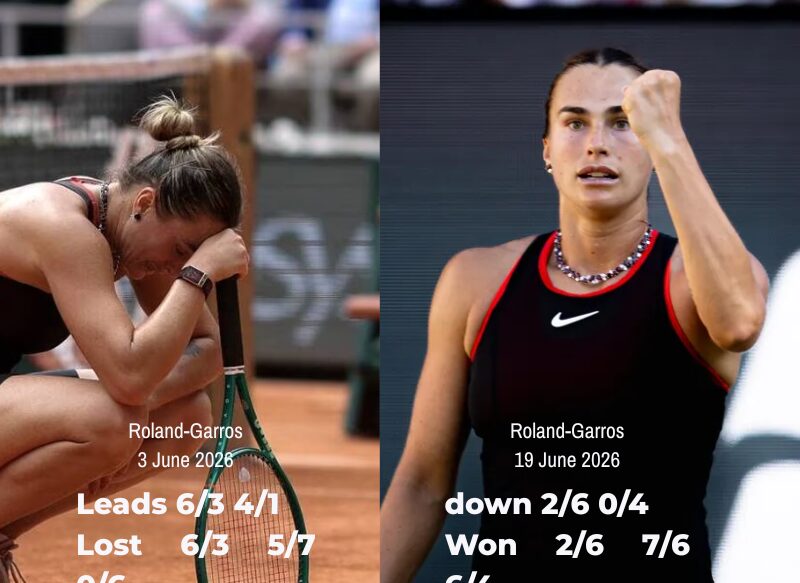
At Roland-Garros 2026, Aryna Sabalenka was the big favorite to win the title. In her quarterfinal match against Diana Shnaider, everything started perfectly. Sabalenka won the first set 6-3 and was leading 4-1 in the second set. She had a double break. The match was in her hands.
Then, the “irrational” reality of tennis happened. Sabalenka lost her rhythm, started overthinking, and lost 10 games in a row. She lost the match 3-6, 7-5, 6-0.
In her press conference, she was extremely honest:
“I guess mentally I got into a very deep, dark hole over there, and I just couldn’t get back mentally on track… Probably I will spend a whole day tomorrow in a smash room destroying stuff to help me feel better.”
The Coaching Lesson:
Every champion faces these deep emotional crashes. It is a natural process of elite sport. As a player or a family, you must respect these down times. You must accept them, rest, clear your head, and then build a plan to return with positive ideas.
And champions always bounce back! Just two weeks later in Berlin, Sabalenka faced Nikola Bartunkova. This time, Sabalenka was down 6-2, 4-0. She was almost defeated, but she fought back and turned the match around to win. She said: “Fortunately, the little tiger inside me came out of its cage to keep fighting.”
This is the beauty of tennis: the momentum can shift at any moment.
2. Jannik Sinner: “No One is a Robot”
Also at Roland-Garros 2026, World No. 1 Jannik Sinner experienced the physical cruelty of tennis.
Sinner was leading Juan Manuel Cerúndolo 6-3, 6-2, 5-1. He was just one game away from a comfortable win. But the temperature in Paris peaked at 33°C (91.4°F). Despite his elite physical preparation, his professional team, and his perfect hydration habits, Sinner suffered a heatstroke and heavy cramping.
He lost the third set, struggled to move in the fourth, and lost the match in five sets. After the match, Sinner said simply:
“No one is a robot. Today was really something different—I had no energy.”
The Coaching Lesson:
No matter how hard you train, environmental variables like extreme heat can destroy a physical structure. This teaches us two things:
Physical preparation must always adapt: You cannot control the weather, but you must respect the limits of the human body.
We must protect the athlete’s recovery: Professional careers are built on workload management and high-performance recovery tools (like cryotherapy and sleep tracking).
3. The Tactical Key: “Closing the Door”
Both Sabalenka and Sinner were leading their matches with scorelines of 4-1 and 5-1. Why is it so hard to finish a match?
On the professional tour, closing a match is a distinct mental requirement. When you are close to winning, your focus can drop by just 1%. But in elite tennis, a 1% drop in intensity is a massive opportunity for your opponent.
The leading player starts to play defensively, trying not to make mistakes.
The losing player feels they have nothing to lose, so they start playing aggressively and fearlessly.
To win at the high level, a player must maintain absolute mental discipline from the first point to the very last point. Finishing a match is a skill that must be trained and analyzed, not ignored.
Conclusion: Beyond the Court
The transition from junior potential to pro reality is not a straight line. It is full of unexpected physical crises and heavy emotional storms.
To survive this journey, talent is not enough. You need:
A highly structured recovery plan to handle physical challenges (like Jannik Sinner’s heatstroke).
A supportive family and coaching circle to help navigate emotional dark places (like Aryna Sabalenka’s Roland-Garros defeat).
Data-driven tactical analysis to understand and control match momentum.
At JuniorToPro, we do not just train tennis players. We build the physical, mental, and tactical structure required to survive the tour’s hardest days.
Is your tennis project structured to survive these international standards?
Don’t guess. Take our free PRI-360™ (Pro Readiness Index) test today to evaluate your current training, logistics, and mental structure across 10 strategic areas.