
The first professional seasons on the ITF World Tennis Tour are where most careers are either launched or quietly abandoned, and money is usually the reason. A W15–W35 season can be planned on a budget, but only if every week is chosen for a reason, priced honestly and connected to the weeks around it.
I am Geoffroy Dupuis, an independent high-performance tennis coach and founder of JuniorToPro, based in Montpellier, France. Many of the players I work with are in the junior-to-pro transition: finishing on the ITF Junior Tour and building a first WTA ranking at W15 and W35 level. This guide sets out the method I use to plan those seasons when the budget is limited, which, for most families, it is.
What are W15 and W35 tournaments?
The ITF World Tennis Tour is the entry level of women’s professional tennis. Its women’s categories are W15, W35, W50, W75 and W100: the higher the number, the higher the prize money and the ranking points on offer. W15 and W35 events are where most players earn their first WTA ranking points. The fields are often strong and deep, with experienced professionals, ambitious juniors and college players all competing for the same points.
Two facts shape every budget at this level:
- Prize money rarely covers the cost of the week for players who lose early. At W15 level in particular, a player should plan to fund her season, not to finance it from results.
- Ranking points count for 52 weeks. A W15 title won in March will drop off the following March. The WTA ranking is built from a player’s best results over that rolling period, so a season is a continuous cycle of earning and defending.
How much does a W15–W35 season cost?
It depends on the number of weeks, the regions, whether a coach travels and how deep the player goes in draws. Rather than quote a figure that would be wrong for most readers, here is the reasoning with round numbers. This is an illustrative example only.
In this example, a player plans 20 tournament weeks. If each week costs between €1,500 (early exit, travelling alone, sharing accommodation) and €3,000 (deep run, travelling with a coach), the season sits somewhere between €30,000 and €60,000 before prize money and funding. That range is wide on purpose. A budget built only on the low figure will be exhausted by the summer.
The good news is that the same 20 weeks can be arranged in ways that cost very different amounts. The rest of this guide is about moving towards the lower end without sacrificing development.
Step 1: Which tournaments can the player actually enter?
Budget planning starts with entry, not geography. Travelling to a W35 only to lose in the first round of qualifying is the most expensive week a player can have: full travel cost, minimal return.
In J2Pro Planner, my own planning tool for the players I coach, every event shows an entry radar: main draw direct, qualifying, or wild card needed. It is based on the real 2025 entry cut-offs for each tournament, so the estimate reflects how strong that particular event’s field has actually been, not a general rule of thumb. For a player on the edge of W15 main draws, this alone prevents several wasted trips a year.
Step 2: How do you build swings instead of single trips?
Think of a season like a delivery route. A driver who returns to the depot after every parcel spends most of the day on the motorway. A driver who plans a loop delivers the same parcels for a fraction of the fuel. Tennis travel works in exactly the same way.
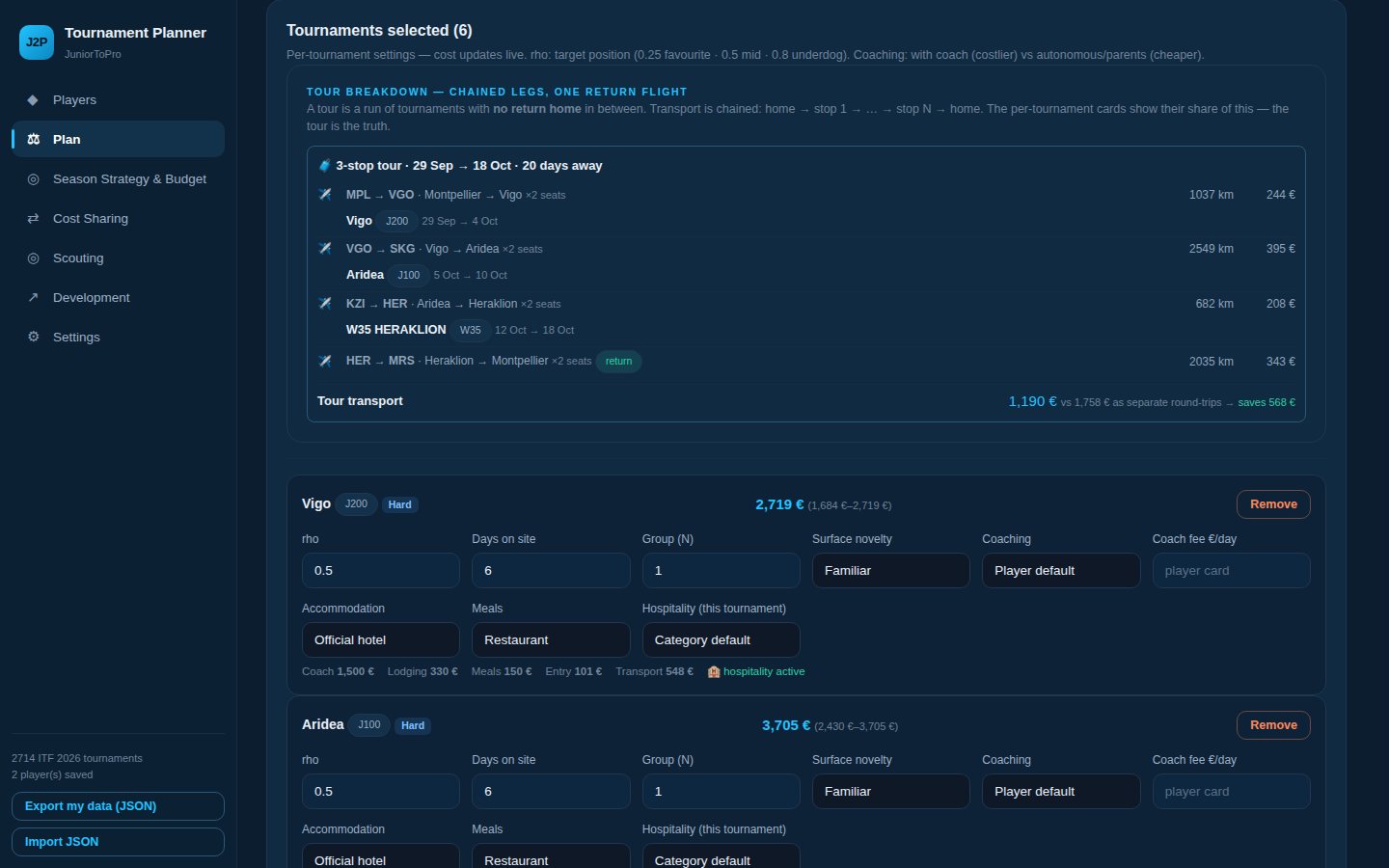
Many W15 and W35 events are organised in clusters: the same venue or region hosting several consecutive weeks. Chaining two, three or four of those events with one return flight transforms the budget. The Planner’s Tour breakdown shows exactly this: it chains away events with a single return flight and displays the saving against separate round trips.
When I ask the Planner to Suggest a plan, it builds swings of two to six tournaments from the dates, regions, surfaces and categories I choose, and it prefers geographically coherent routes. Each swing shows the route and airports, freshness after back-to-back weeks, the points it can re-defend, and a cost range.
A practical rule on swing length
Long swings are cheaper per week, but fatigue is real. After three or four consecutive tournament weeks, performance and motivation often drop. The Planner flags freshness across back-to-back weeks, and I adjust the plan with the player’s physical data and schedule in mind.
Step 3: Price every week as a range
A W15 week does not have one cost. It has a range, because the number of nights, meals and coaching days depends on how far the player goes. The Planner calculates a low–high cost range for each event from the coach’s day rate, days on site, accommodation type, meals, entry fees and transfers. Where the tournament offers ITF hospitality to eligible players, the rules by category and round are applied, and the season plan lets me record whether the hospitality letter has been secured.
Seeing the range changes decisions. A family may accept an expensive long-haul swing when the low end is manageable, and decline it when even the low end would consume a quarter of the season’s budget.
Step 4: Share costs with another player
Travelling with a coach is a real advantage at W15–W35 level: scouting, match plans, load management and recovery all improve. It is also the largest single cost line. The simplest way to reduce it is to share.
The Planner’s Cost Sharing view shows the solo cost against the grouped cost when two or more players attend the same event. In its model, two players each pay 70% of the coach fee rather than 100%, and share transfers too. Over a 20-week season, that difference is significant, provided both players are at a similar level and follow compatible calendars.
Step 5: Track funding and the real net cost
Most transition-age players are funded by a mix of family, sponsors, local grants and occasional prize money. The Planner records dated funding credits (grants, sponsors, family) and shows how they reduce the net cost of the season. The budget view tracks the budget target against what remains, and breaks spending down by coach, lodging, meals, entry, transfers and transport. A PDF export makes it easy to share the plan with a sponsor.
Step 6: Do not let the budget make the player a points farmer
When money is tight, it is tempting to chase the weakest, cheapest fields to collect points. It works briefly, then it stalls. The Planner’s development index rewards dense, challenging fields and surfaces relevant to the player’s project, which helps me balance cheap points against real progress. For more on this trade-off, read Points per Euro: Choosing the Right Tournaments.
A season-planning checklist for W15–W35 players
- Set a realistic budget range and list confirmed and possible funding.
- Check entry chances for every candidate event before looking at flights.
- Group events into swings of two to four weeks around one return flight.
- Price each week as a low–high range, including coaching.
- Identify players to share a coach and transfers with.
- Compare points to defend with points expected over the next 52 weeks.
- Review the plan every few weeks as results and ranking change.
This work is part of the tennis career management I provide, and the season plan is shared with the player, family and staff through J2Pro Circuit. For the wider programme, see my junior-to-pro tennis coaching page.
Frequently asked questions
How many tournaments should a W15–W35 player play in a season?
There is no universal number. It depends on the player’s level, budget, physical capacity and objectives. What matters most is that each week has a clear purpose and that events are grouped into efficient swings with recovery built in.
Is it cheaper to travel without a coach?
The direct cost is lower, but the value per week can also be lower: less preparation, scouting and recovery. Sharing a coach with another player of similar level is often the best compromise on a limited budget.
What is ITF hospitality?
Some ITF World Tennis Tour events provide accommodation to eligible players, depending on the category, the tournament and the round reached. Always check the tournament’s fact sheet and confirm the hospitality arrangement before booking.
Should a budget-limited player focus on W15 or W35 events?
It depends on entry chances and level. A player safely in W15 main draws may gain more there at first; a player who regularly wins W15 rounds should test herself at W35 level. Entry cut-offs are the best starting point for that decision.
How does J2Pro Planner help with a limited budget?
It shows entry chances from real 2025 cut-offs, cost ranges per event, savings from chaining trips, shared-coach costs, funding credits and euros per ranking point, so every week of the season can be justified. It is my own tool, used for the players I coach. Learn more on the J2Pro Planner page.
Read next: Tennis Is Expensive: Why Your Tournament Schedule Is an Investment Strategy · Points per Euro: Choosing the Right Tournaments
Plan your first professional season
Take the free PRI-360™ Pro Readiness test to measure how ready you are for the ITF World Tennis Tour, or book a call to build a W15–W35 season that fits your budget.