
Two tournaments can cost the same and return completely different value. “Points per euro” is the simplest way to compare them: how many ranking points each euro of the budget is likely to buy. Used well, it saves thousands. Used alone, it can quietly damage a player’s development.
I am Geoffroy Dupuis, founder of JuniorToPro and an independent high-performance tennis coach based in Montpellier, France, working with players on the ITF Junior Tour, the ITF World Tennis Tour and the WTA. Choosing tournaments is one of the most consequential decisions in a player’s season, and it is usually made on instinct. This article explains how I compare events using cost per ranking point, where that measure is useful, where it misleads, and how I combine it with other criteria.
What does “points per euro” mean in tennis?
The idea is simple. For each tournament, estimate the total cost of the week and the ranking points the player can realistically expect. Divide one by the other and you get a price per point. In practice I usually express it the other way round, as euros per point, because families find it easier to read: “this event costs us about €100 for every point we expect to earn.”
Think of it like fuel economy. Two cars can have the same price, but one takes you twice as far on a full tank. Euros per point tells you how far the budget will carry the ranking.
How do you calculate euros per ranking point?
You need two estimates, and both must be honest.
1. The expected cost
Travel, accommodation, meals, entry fees, transfers and coaching. Because the number of nights and coaching days depends on how far the player goes, the cost is a range, not a single figure.
2. The expected points
This is not “the points for winning the tournament”. It is the points for each round, weighted by the realistic chance of reaching it. A player who has roughly a coin-flip chance in her first match does not “expect” the points for the final; she expects a much smaller, probability-weighted number.
Here is an illustrative example with round numbers, not official points or prices. Imagine two events:
- Event A: a W15 close to home. Cost in this example: €1,200. The player is seeded in the main draw. Expected points in this example: 8.
- Event B: a W35 requiring a long flight. Cost in this example: €2,800. The player must play qualifying. Expected points in this example: 4.
In this example, Event A costs €150 per expected point and Event B costs €700 per expected point. On this measure alone, A is almost five times better value. That is the power of the metric: it turns a vague feeling (“B is a bigger tournament”) into a comparable number.
Why is euros per point not enough on its own?
Because a ranking is a means, not the goal. The goal is a player who can win at the next level. If every decision were made on euros per point, the player would always pick the weakest, cheapest fields she can find. Her ranking would rise for a season, and then stall the moment she had to compete with stronger players. This is often called “points farming”.
In my example, Event B might be exactly what the player needs: a stronger field, a different surface, the experience of winning qualifying matches under pressure. The question is not “which event is cheapest per point?” but “which combination of events gives the best balance of points, development and cost over the season?”
What else should you consider when choosing tournaments?
- Entry chances. Main draw direct, qualifying or wild card: this changes both cost and expected points.
- Field strength. Dense, challenging draws develop a player faster than easy ones.
- Surface. Does the event build experience on the surface that matters for the player’s project?
- Points to defend. Ranking points count for 52 weeks. An event that replaces an expiring result is worth more than it looks.
- Connections. An event that chains with the weeks before and after is cheaper than an isolated trip.
- Recovery and freshness. A fourth consecutive week is rarely as productive as the first.
How J2Pro Planner compares tournaments
J2Pro Planner is the tool I built to make these comparisons quickly and consistently for the players I coach. It is my own tool and is not sold separately. It covers the 2026 calendars of the ITF Junior Tour, the ITF World Tennis Tour, the WTA, the ATP, the ATP Challenger and the UTR Pro Tennis Tour.
Expected points, not dream points
For junior events, win expectation is based on the World Tennis Number (WTN): in the Planner’s model, a 3-point WTN gap corresponds to roughly a 75% chance of winning the match, and a first time on a surface pulls the odds towards 50/50. For professional events, the Planner compares the player’s level and surface with each category’s field level and applies the official points tables.
Entry radar from real cut-offs
Each event shows whether the player is likely to be in the main draw, in qualifying or in need of a wild card, based on the real 2025 entry cut-offs for that tournament.
Cost ranges and euros per point
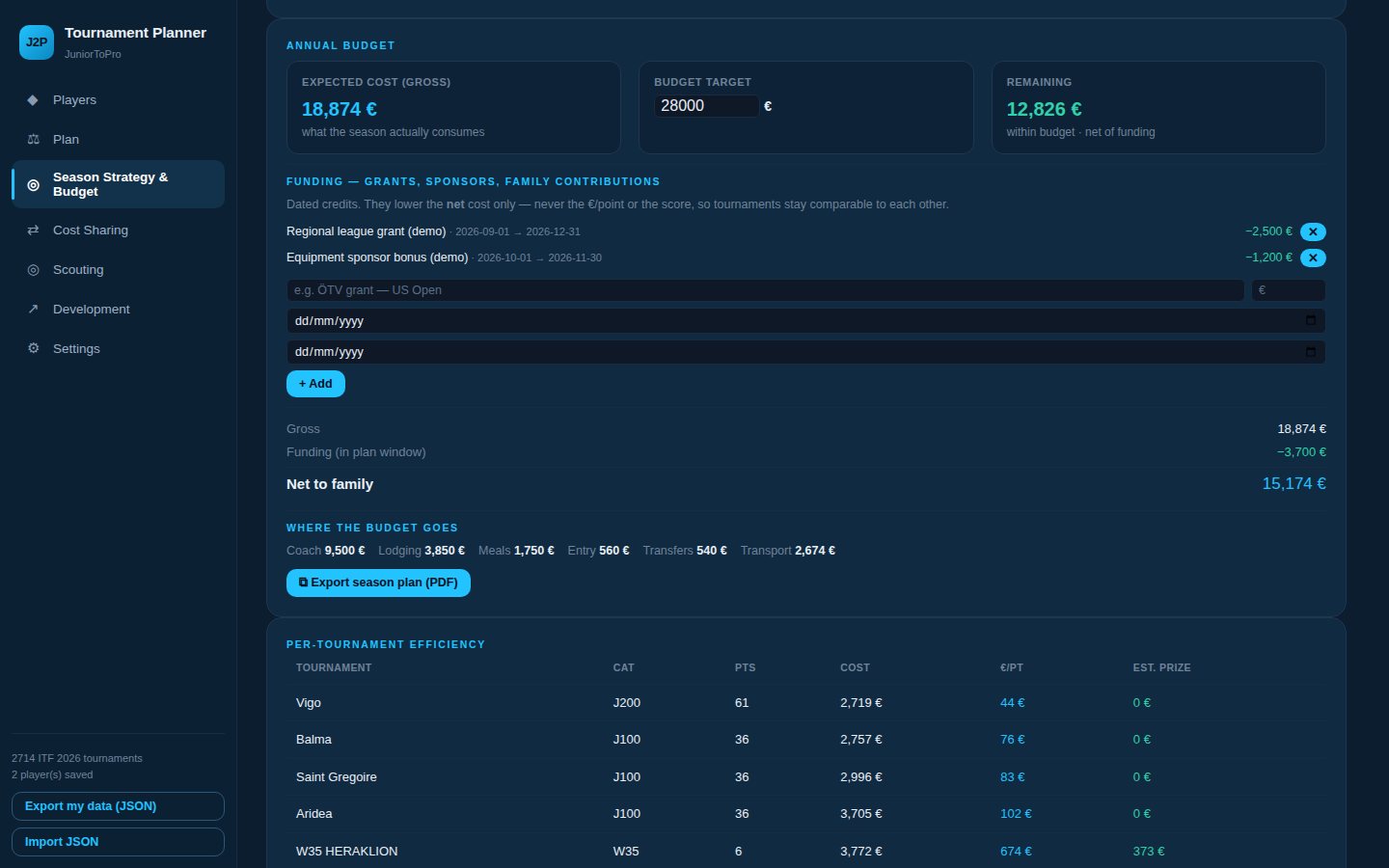
Each event is priced as a low–high range, from an early exit to a deep run. The Season Strategy & Budget view shows euros per point for each tournament and for the whole season, the net cost after estimated prize money, and the spread between early exits and deep runs.
A development index against points farming
A development index rewards dense, challenging fields and surfaces relevant to the player’s project. In the player’s profile, a slider lets me set the balance between “ranking first” and “development first”, so an 18-year-old chasing her first ranking and a 22-year-old consolidating at W35 level get different recommendations.
Defend versus earn
The Planner compares the points expiring over the coming weeks with the points each plan is expected to bring, net of the results that would replace them. It is the honest answer to “is this season moving us forward?”
Checking the results afterwards
In the Development view, the player’s results record shows expected against actual points and the euros per point for each result, with the official best-results rules of each ranking applied (only a limited number of best results count, and doubles count partly in the ITF junior ranking). Over time this shows whether the schedule is delivering what we planned.
Auditing the last 12 months
When I assess a new player, the Planner’s 12-month scheduling audit checks the level of the events played against the real fields, the surface split, trips that could have been chained, the junior/senior balance and gaps in the calendar. It is often the fastest way to find money that was wasted without anyone noticing.
How to use euros per point in practice
- Shortlist events the player can realistically enter.
- Estimate expected points honestly, round by round.
- Price each event as a range, including coaching.
- Calculate euros per point, then check the development value.
- Group the best candidates into efficient swings.
- Review actual points against expected points after each swing.
Choosing tournaments is one part of the tennis career management I provide within my junior-to-pro tennis coaching. The final schedule is shared with the player, family and staff through J2Pro Circuit.
Frequently asked questions
What is a good euros-per-point figure?
There is no universal benchmark: it depends on the category, the region and whether a coach travels. The figure is most useful for comparing events for the same player, and for tracking whether the season is becoming more or less efficient.
Should I always choose the tournament with the lowest cost per point?
No. The cheapest points often come from weak fields that do little for development. Balance euros per point with field strength, surface and the player’s long-term objectives.
What is points farming in tennis?
Points farming means repeatedly entering weak fields to collect ranking points cheaply. It can raise a ranking for a while, but it slows development and often leaves the player unprepared when she moves up a category.
How long do ranking points count?
WTA and ITF ranking points count for 52 weeks. A good tournament choice therefore considers which points are about to expire and whether a new event can replace them.
Can families access J2Pro Planner?
J2Pro Planner is my own tool, used for the players I coach and advise. It is not sold separately. Find out more on the J2Pro Planner page.
Read next: Tennis Is Expensive: Why Your Tournament Schedule Is an Investment Strategy · How to Plan a W15–W35 Season on a Budget
Make every euro count
Take the free PRI-360™ Pro Readiness test to see where your project stands, or book a call to compare your next tournaments with me.