
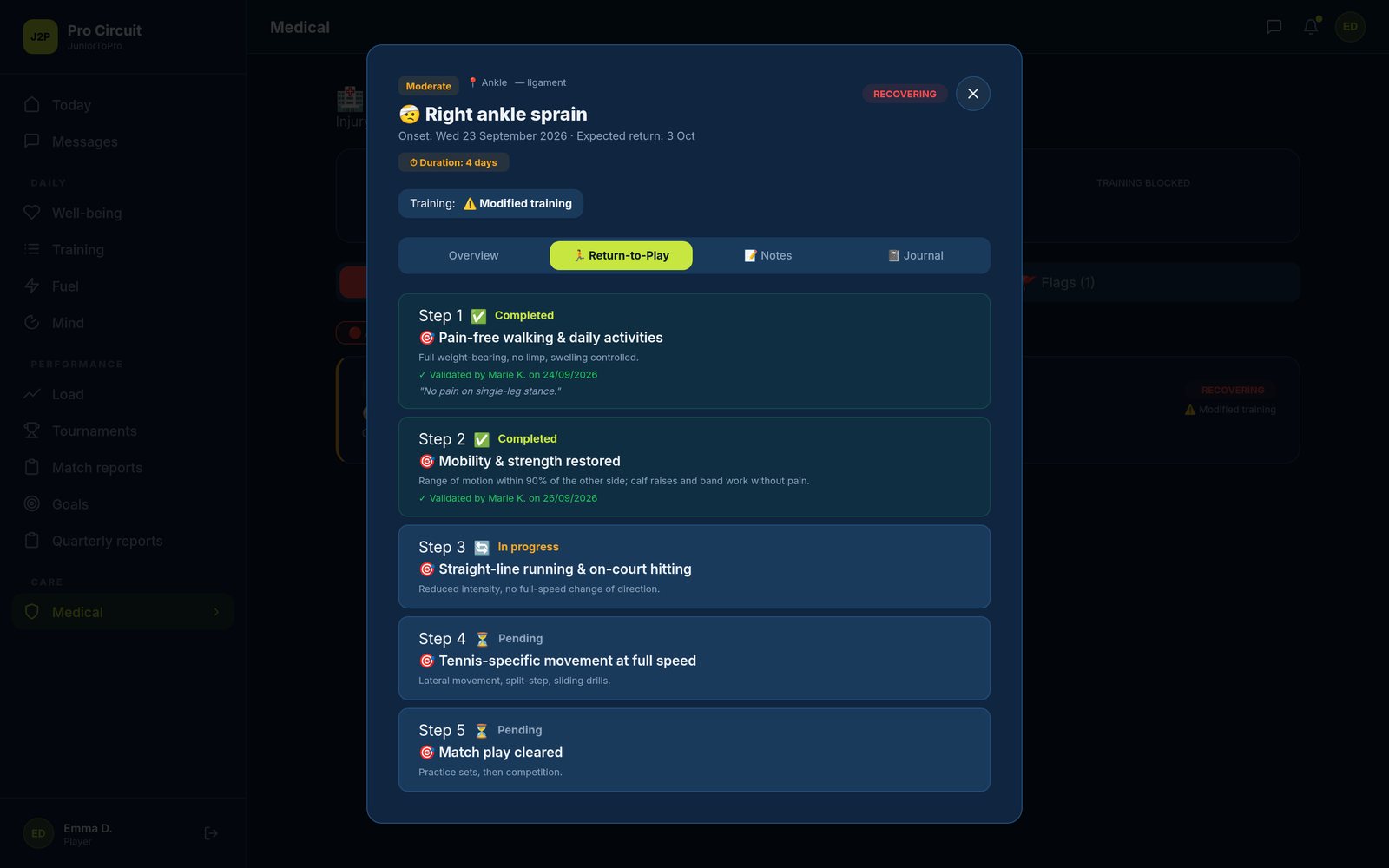
After an injury, the most dangerous moment is often not the injury itself but the return. Coming back too fast, or skipping a stage because a tournament is coming, is one of the most common reasons players get hurt again.
I am Geoffroy Dupuis, founder of JuniorToPro, an independent high-performance coach working with players on the ITF Junior Tour, the ITF World Tennis Tour and the WTA. Over more than twenty years on tour I have accompanied many players back from injury. This article explains how a structured, five-step return to play works, how we organise it in our J2Pro Circuit app, and what the player, the parents and the coach should — and should not — decide.
An important point first: this article is general information, not medical advice. Every return-to-play decision is made with the player’s physiotherapist and doctor. As a coach, my role is to adapt the tennis and the physical work to their decisions — never to replace them.
What is a return-to-play protocol?
A return-to-play protocol is a step-by-step plan that brings an injured player from treatment back to full competition. Each step has clear criteria that must be met before moving to the next. It is often described as a continuum: first returning to participation (training, with restrictions), then to sport (competition), then to performance (competing at the previous level or higher).
Think of it like climbing a staircase rather than jumping onto a platform. Each step tests the body a little more than the last one. If a step causes a problem, you go back down one, not all the way to the bottom — and you never skip two steps at once.
Why is a structured return to play so important in tennis?
Tennis is a sport of repeated, explosive and asymmetrical efforts: sprints and sudden stops, lateral changes of direction, and thousands of serves and overheads placing load on the shoulder. A player can feel fine walking or jogging and still not be ready for a three-set match on clay.
The tournament calendar adds pressure. There is always a “next event”, ranking points to defend or a wild card that seems too good to miss. A written protocol protects the player from those short-term decisions, because the criteria are agreed in advance and are the same whatever the calendar says.
What are the 5 steps of return to play?
The exact content of each step depends on the injury and is defined by the medical staff. The logic, however, is always a progression from protection to performance. Here is how I explain the five steps to players and families.
Step 1 — Diagnosis, protection and treatment
The physiotherapist or doctor assesses the injury, establishes a diagnosis and sets the treatment and the training restrictions. The player may keep training the parts of the body that are not affected, within those limits. The goal of this step is simple: let the injured tissue start healing and avoid making things worse.
Step 2 — Restoring movement and strength
Under medical guidance, the player works on regaining range of motion, strength and control around the injured area. This is where objective testing is valuable. I use Kinvent tools — K-Plates for force and jump tests, K-Move for movement measures and K-Grip for grip strength — to compare the injured and healthy sides and give the medical staff data rather than impressions.
Step 3 — Sport-specific movement off court or at low intensity
Once the medical staff agree, the player reintroduces tennis-type movement: footwork patterns, changes of direction, shadow swings, then gentle hitting. Reaction work with Blazepod lights can be introduced progressively here, because it recreates the unpredictability of tennis in a controlled way.
Step 4 — Return to full training
The player returns to normal practice, with volume and intensity built up progressively: longer rallies, serving, point play, then practice matches. This is the stage where training load monitoring is essential, because the temptation is to go from “almost nothing” to “everything” in a few days. A sudden jump in load is exactly what we try to avoid. I explain how we track it in “Training load explained for parents: TRIMP, ACWR and monotony”.
Step 5 — Return to competition
The player is cleared to compete. Even then, the first tournament is chosen carefully — surface, travel, draw size — and the schedule around it stays lighter than usual. Returning to performance, meaning her previous level, can take longer than returning to competition, and that is normal.
Who decides when a player can move to the next step?
The medical staff decide on the medical criteria; the coach adapts the tennis and physical work to them; the player gives honest feedback about pain and confidence. Parents are informed and supported, but the decision to progress should never come from pressure — whether from a tournament deadline, a sponsor or the player’s own impatience.
In J2Pro Circuit, this is built into the Medical module. Injuries are recorded with diagnosis, mechanism, treatment and training restriction, and medical flags can restrict or block training. The app includes a 5-step return-to-play protocol in which the staff validate or block each step. Nobody moves forward on a whim: each progression is a recorded decision by the staff responsible for it, and the physio, osteopath and sport doctor roles have full medical management.
How do we monitor the player during the return?
Three sources of information work together:
- The daily wellbeing check-in: morning and evening, producing a Hooper score and a readiness level (green, yellow or red). A worsening trend is a reason to pause. See “Why a daily wellbeing check-in prevents injuries”.
- Training load: session RPE × minutes, with ACWR, monotony and strain, so the rebuild stays progressive.
- The injury journal: a private journal where the player records her mood and her pain level. It helps her and the staff see the real trajectory, day by day, rather than relying on memory.
Recovery habits — sleep, nutrition, hydration — matter even more during this period. Our guide to recovery as invisible training covers them in detail.
What about the mental side of returning from injury?
Many players are physically ready before they are mentally ready. Fear of re-injury can show up as hesitation on a stretch shot, a slower serve or avoiding a movement. This is normal and needs to be addressed, not ignored. Gradual exposure — the same staircase logic — helps rebuild confidence along with the tissue. Our page on physical and mental training explains how we connect the two.
How is the player’s privacy protected during an injury?
Injury is a sensitive time, and trust matters. In J2Pro Circuit:
- The player controls sharing of her injury journal. By default, all staff attached to her can see it; she can limit access to named people, but only narrow it, never widen it.
- The head coach can never be excluded, so the person responsible for her programme is always informed.
- Journal entries she has not shared never reach the staff.
- Parents see readiness only, never pain levels or free notes, and can exchange messages with the coach.
This balance lets the player write honestly about pain and doubts, while the team still sees the signals needed to keep her safe.
Read next: all J2Pro Circuit articles.
Frequently asked questions
How long does return to play take after a tennis injury?
It depends entirely on the injury, its severity and the player. There is no standard timeline: the physiotherapist or doctor sets the criteria, and the player moves to the next step only when they are met.
Who decides when a tennis player can return to competition?
The medical staff — physiotherapist and doctor — make the return-to-play decision. The coach adapts training to their decisions, and the player’s honest feedback on pain and confidence is part of the process.
Can a player skip a step if she feels fine?
No. Feeling fine at rest does not mean the body is ready for the demands of tennis. Each step tests the body a little more; skipping one removes that safety check.
What happens if pain returns during the protocol?
The player reports it, the medical staff reassess, and the progression is paused or moved back a step. In J2Pro Circuit, staff can block a step and medical flags can restrict training.
Can parents follow the return-to-play process?
Yes, within privacy limits. Parents see the player’s readiness level, the tournament calendar and reports, and can message the coach. They do not see pain levels or the player’s private notes.
Plan a safe return
Discover how the Medical module works in J2Pro Circuit, or book a call to discuss how we coordinate with your player’s medical team.