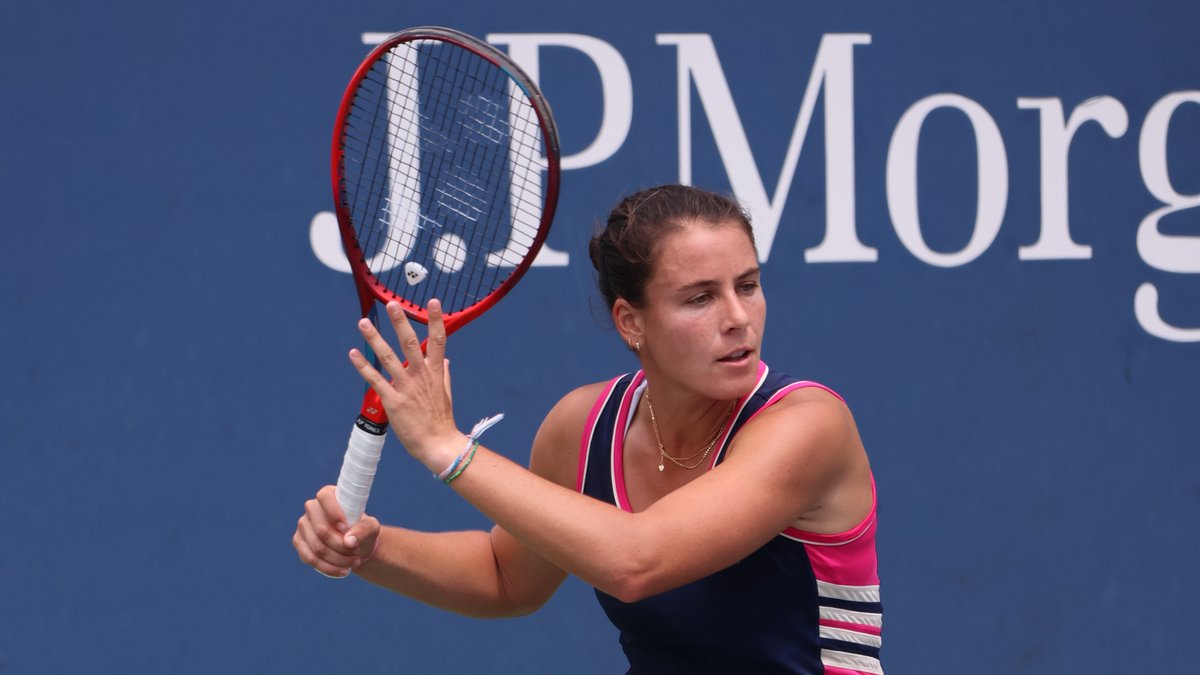
Header photo: Emma Navarro at the 2023 US Open, via Wikimedia Commons (Creative Commons licence), cropped.
On 30 September 2026, Emma Navarro ended her season early and explained why: almost three years of Relative Energy Deficiency in Sport (REDs), complicated by Hashimoto’s hypothyroidism. Her words are some of the most useful a professional player has ever shared with juniors, parents and coaches. The Emma Navarro REDs case leaves us with one question: not who failed, but how this can stay invisible for so long in a sport where players are watched every day.
I am Geoffroy Dupuis, founder of JuniorToPro and an independent high-performance and travelling tennis coach based in Montpellier, in the South of France. I work with players on the ITF Junior circuit, the ITF World Tennis Tour and the WTA. This article is written with respect for Emma and for the people around her. Its purpose is to understand, and to find solutions.
First, thank you, Emma
It takes courage to write publicly that you lost your health while doing what you believed professional athletes are supposed to do. Navarro explained that the problems began almost three years ago, that they were heavily influenced by choices she made early in her professional career, and that she believed getting lean was the way to optimise performance. She described dizziness, brain fog, mood swings, a weakened immune system and heavy fatigue, and wrote that she had been under-fuelling for almost three years.
One sentence from her letter should be printed in every junior academy: “There is no weight on the scale or leanness in your limbs that is more valuable than your health or your well-being.” And another one shows exactly why this matters: “I gained some weight this year. But I also gained my life back.”
She is skipping the end of the 2026 season to adjust her treatment and her fuelling, with the aim of returning in 2027. The process will be long. Her health comes first, and she has my full support.
Emma Navarro REDs diagnosis: what REDs actually is
REDs stands for Relative Energy Deficiency in Sport. The International Olympic Committee updated its consensus statement on the syndrome in 2023 (Mountjoy et al., British Journal of Sports Medicine). The core idea is simple to state and hard to see in real life:
- Energy availability is what is left for the body to function after training and matches have taken their share. It is calculated as energy intake minus exercise energy expenditure, relative to fat-free mass.
- When that remainder is too low for too long, the body goes into protection mode. It reduces what it considers non-essential: hormonal function, bone remodelling, immunity, muscle repair, metabolic rate.
- The consequences touch health (bone stress injuries, frequent illness, menstrual disruption in women, low testosterone in men, gut and cardiovascular effects, mood) and performance (reduced training response, slower recovery, poorer concentration and decision-making, more injuries).
Think of it like a phone in low-power mode. The screen still works and calls still go through, so from the outside everything looks fine. But the background apps have been switched off, and the battery drains faster every day. A player in low energy availability can still win matches. What has been switched off is the system that keeps her healthy over a season.
Two points are often misunderstood:
- REDs is not an eating disorder by definition. It can come from disordered eating, but it very often comes from an unintentional mismatch: a heavy schedule, poor access to food, or a belief that lighter is better.
- REDs is not only a women’s issue. Male players are affected too, with different markers.
Diagnosis is always medical. The IOC proposes a clinical assessment tool (REDs CAT2) for doctors. A coach does not diagnose. A coach notices, asks, and refers.
REDs in tennis: why our sport is high-risk for under-fuelling
Tennis combines almost every risk factor:
- Unpredictable energy demand. A first-round match can last 55 minutes or three hours. The next match time depends on the previous one, so meals are planned around a schedule nobody controls.
- Constant travel. Thirty weeks or more a year away from home, time zones, airport food, tournament canteens and hotel breakfasts that are not built for an athlete.
- A culture that rewards leanness. Weight loss is often praised before anyone asks how it was achieved. “You look fit” is the most dangerous compliment in the locker room.
- Adolescence on tour. Junior players are still growing. Energy, protein and calcium needs rise during growth spurts, which is exactly when an energy gap does the most damage.
Emma Navarro REDs: how can it take three years to see?
This is the real question for any staff that wants to improve. Navarro had access to high-level professionals. I do not know the details of her team’s work, and I will not pretend to. But from my own years on tour, I can see five mechanisms that make REDs hard to detect anywhere, including in very good teams.
1. The signals look like normal tour life
Fatigue, a cold, a bad week, irritability, poor sleep: every player on tour has them. Taken one by one, each signal has an ordinary explanation such as jet lag, a long match or a virus. REDs is not in any single symptom. It is in the pattern over months.
2. Results do not drop immediately
A player can perform for a long time on reserves. Navarro’s career-high ranking of world No. 8 came during the same period. When results are good, nobody questions the method. That is precisely why we cannot use results as our health indicator.
3. Each professional sees one piece
The coach sees the court. The fitness coach sees the gym. The physio sees the injury. The nutritionist sees a food diary, if there is one. The doctor sees a blood test, once in a while. Each piece can look acceptable. Nobody owns the whole picture, and data sits in different notebooks, phones and email threads.
It is like a cockpit where each pilot watches only one gauge. Every gauge is in the green zone, yet the aircraft has been slowly losing altitude for an hour. You only see it when someone looks at all the instruments together, over time.
4. The athlete does not know what to report
Navarro wrote that she pushed through symptoms without understanding what caused them, and believed she was doing the right thing. If a player has never been taught that dizziness, losing her period or constant hunger are warning signs, she will not mention them. You cannot report what you do not recognise.
5. There is no safe space to talk about it
Weight, food, the menstrual cycle and mood are personal subjects. Many players, especially young women, will not raise them spontaneously with a coach, and even less in front of a parent or an agent. If the team has not created a regular, private and judgement-free moment for these conversations, the information never arrives.
None of this is about blame. A high-quality coach, a high-quality staff, anyone who wants a player to perform, will ask these questions after a case like this. That is what improving looks like.
From awareness to action: two levers
There is no miracle solution. But there are two levers that every team can pull.
Lever 1: educate and empower the player
- Teach what REDs is, early, ideally from 13 or 14, before the first big weight changes.
- Replace myths with facts. “Cutting carbs keeps you light”: carbohydrate is the fuel of the sport, and cutting it reduces the capacity to play at high intensity.
- Make the player responsible for reporting, and give her a simple daily way to do it.
Lever 2: detect and act as a staff
- Track a few signals every day, not once a quarter: well-being, sleep, fatigue, body weight trend, training load.
- Define thresholds that automatically trigger a conversation, not a judgement.
- Share the picture between coach, fitness, physio and medical staff, so that someone sees the pattern.
- Refer to a doctor as soon as the pattern persists.
How we apply this in J2P Pro Circuit
This is the reason I built J2P Pro Circuit, the athlete platform behind my coaching. It does not replace a doctor and does not make any diagnosis. Its role is to make sure the signals are seen early, by the right people, and turned into a conversation.
The Fuel module: education first
- Players learn what REDs and energy availability are, with references to the 2023 IOC consensus.
- Fuel targets adapt to the day: training, match, travel, recovery, growth spurt.
- One rule is built into the module: every number errs upward, never downward. Giving a little too much carries a risk that is nothing like the risk of giving too little.
Daily well-being: the early-warning system
Every morning, the player completes a short well-being check-in covering sleep, fatigue, stress and muscle soreness, adjusted during tournament weeks. Combined with training load indicators (TRIMP, monotony and ACWR), it shows whether the body is absorbing the work or running on reserves.
Flags that start conversations
- Fast weight loss: a drop of around 2 % or more in about a week raises a flag. The message to the player is clear: either dehydration or an energy gap, and neither is a performance strategy.
- Red readiness days: the app reminds the player that “a red day is a recovery day, not a diet day”. If it repeats, the next step is a conversation with the coach, with energy availability as the first question.
- High fatigue or stress scores alert the coach to review the training load before the next session.
- Sleep debt over several nights triggers specific recovery and fuelling advice.
One shared picture for the whole team
Coach, fitness, physio, family and agent work from the same information, each with the access that fits their role. Sensitive data stays private by default. When something goes wrong, the injury journal and the return-to-play protocol keep everyone aligned.
Performance is not only a forehand
A great forehand, a reliable serve and the right decision at 4-4, 30-40 are part of high performance. But a player who performs with a body that is healthy and a mind at peace will go further, and for longer. Athletes are now pushing staffs to take well-being seriously, and they are right to. Navarro’s letter is part of that movement.
The return to play: performing and happy again
Coming back from REDs is not just getting back on court. It means:
- Medical clearance first, with the doctor and physio leading.
- A progressive return-to-play, each step validated by the staff.
- Fuel, load and well-being tracked daily, without spikes and without guesswork.
- Back to competition when both body and mind are ready, and when the player has found pleasure in playing again.
The goal is not only to make the athlete perform again. It is to make her perform again while being happy to play.
Today, and tomorrow
Emma Navarro’s road back will take time, and the most important thing is her health. Her testimony gives the whole tennis world a chance to learn. Tomorrow, with the next generation of juniors, we have no excuse to repeat the same mistakes.
If you are a player, a parent or an agent and want to know how your current tracking handles fuel and well-being, you can book a call with me or discover J2P Pro Circuit.
Sources
- Emma Navarro, Instagram statement, 30 September 2026, as reported by 93.3 The Drive and 10sBalls.
- Mountjoy M, et al. 2023 International Olympic Committee’s (IOC) consensus statement on Relative Energy Deficiency in Sport (REDs). Br J Sports Med 2023;57:1073–1097.
This article is for information only and does not replace medical advice. If you recognise these signs in yourself or a player, speak to a doctor.