

When a young tennis player wants to transition to the pro tour, families and coaches must look at the real data. The journey is long and involves many hidden factors. In this case study, we decode the exact physical test of a high-potential 15-year-old player to prepare them for the elite level.
Part 1 - Force Asymmetry & Injury Prevention
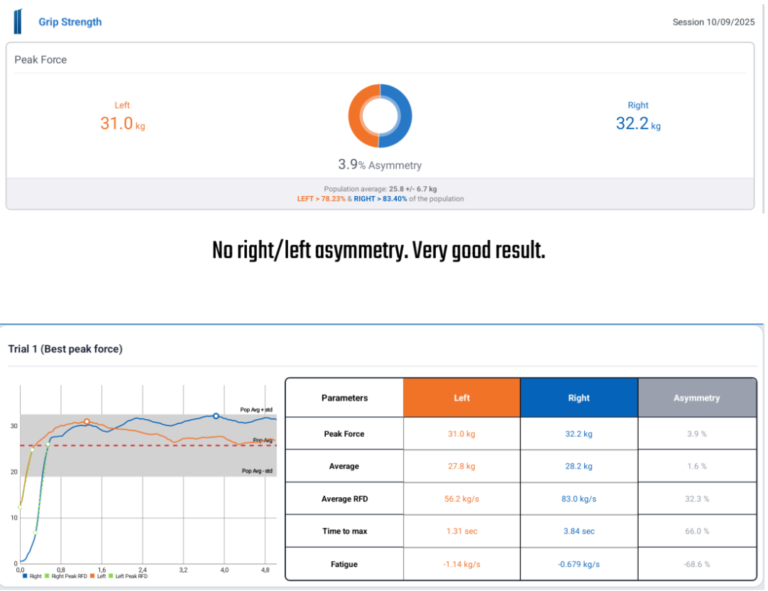
Whilst on-court tennis training is central, the physical balance of the body dictates tour longevity. Science proves that if one side of the body is 15% stronger than the other, the risk of injury during intensive training spikes dramatically.
"The Grip & Squat Baseline:" The athlete showed an excellent, healthy balance in the upper body and legs (only 3.9% and 0.6% asymmetry).
""The Hamstring Warning:" We detected a 14% force difference on the back of the legs during the bridge test.
The Action Plan:" Above 15%, intensive training becomes dangerous. The conditioning staff must immediately isolate and strengthen the weaker side to protect the athlete.
Nothing is left to chance. By knowing exactly how the muscles generate force, the physical trainer can adjust every weight session to build a bulletproof body before the athlete travels to international tournaments.
Part 2 - Postural Control & Natural Preferences
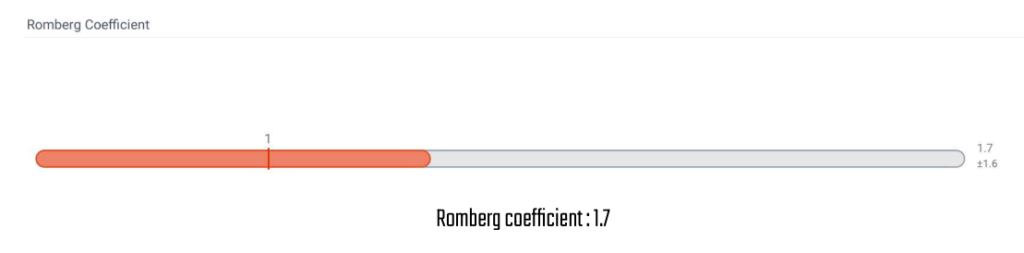
When you move fast, slide on clay, or change directions sharply, your body must maintain perfect balance automatically. To evaluate this, we use the Romberg Test to see if the player relies too much on their eyes or on their internal body feeling (proprioception)
"The Vision Dependence:" The player has a high reliance on sight to stay stable. On court, your eyes must look at the ball, not at your feet.
"The Right Leg Anchor:" The data proved that the right leg is the natural pillar for static balance. "The Closed Stance Preference:" This right-leg dominance perfectly explains why the player naturally prefers a closed stance on the backhand side to lock into the ground.
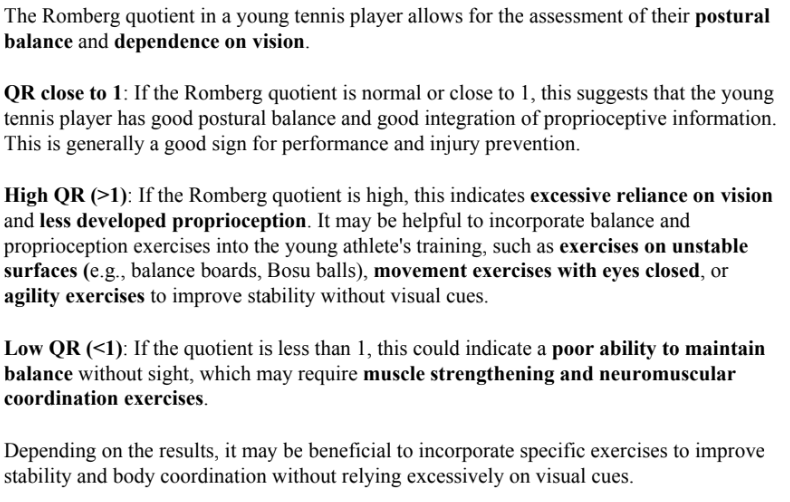
A player becomes more than just a tennis player; they are an elite kinetic chain. We do not try to change the player’s natural motor preferences. Instead, the tennis coach uses this data to make on-court movement more efficient, and we integrate closed-eyes balance routines (like Bosu ball work) into the daily warm-up to automate reactions.
The player, her family and the fitness coaches were provided with a recommended training plan to correct this asymmetry and used to improve the Romberg coefficient.. This plan is not detailed here. It may be included in a future case study.
Conclusion
The tennis coach, the physical trainer, and the medical team now work with the exact same data. This is how JuniorToPro eliminates fragmentation and ensures an uncompromising pathway straight to the top.