

The Background: Moving to Europe for the Grand Slams
The Player: An international junior female player, 16 years old, ranked in the ITF Top 100.
The Goal: Reach the ITF Junior Top 30 by the end of the year and start playing professional tournaments.
The Challenge: Moving to Europe from March to August 2025 to play big tournaments, including the Junior Grand Slams: Roland Garros and Wimbledon.
The J2PRO Role: Performance Manager. I was not her daily, on-court tennis coach. Her father me to join her existing team to handle the global strategy, the schedule, and the budget.
Our Strategy: The Perfect Balance of Wins and Losses
In professional tennis, a bad schedule can ruin a player’s career. Choosing tournaments is a science. To help a player improve, a Performance Manager must find the perfect balance between winning and losing.
⚖️ The Winning Rule
Winning too much? If a player wins every match too easily, they stop improving. They do not learn how to fix their mistakes because they are never pushed to their limits.
Losing too much? If a player loses all the time because the level is too high, they lose their confidence, their rhythm, and their motivation.
The Strategy: The schedule must include tournaments where the player is the favorite (to win matches and build confidence) mixed with harder tournaments (to challenge their skills and force them to grow).
The Execution: Smart Planning & Budget Control
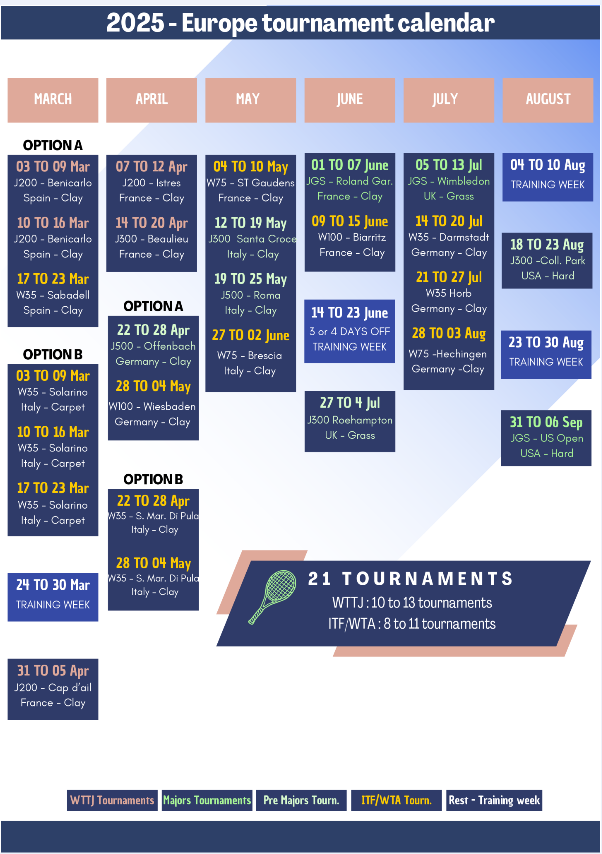
As you can see on the master calendar image_d3bf43.png, I built a highly structured roadmap called the “2025 – Europe tournament calendar”.
The plan included a total of 21 tournaments, carefully split into two goals:
10 to 13 Junior tournaments (WTTJ) to get enough points for the Top 30.
8 to 11 Professional tournaments (ITF/WTA) to start her pro career.
Saving Money and Energy
Traveling for international tennis is very expensive. We optimized the calendar to help the family budget and keep the player fresh:
Smart Travel Routes: We grouped tournaments in regions close to each other (like Spain and France) to avoid long, expensive flights and jet lag.
Free Hospitality: We prioritized tournaments that offered free hotel rooms and food for the player and the coach.
Option A and Option B: As you can see in March and April, we built flexible options. This allowed us to change plans instantly if the player was too tired or needed more points.
The Results: Goal Achieved & WTA Breakthrough
A long-term plan always needs small adjustments. We successfully followed 85% of the original plan. We even added a professional tournament (W15) in Tunisia during the tour, which she won!
By the end of the season, our pragmatic approach brought amazing results:
Junior Circuit: She reached her main goal and finished the year inside the ITF Junior Top 30.
Professional Circuit: With the confidence she built in Europe, she played pro tournaments in her home country. She skyrocketed from a WTA ranking of 800-850 directly into the WTA Top 500.
Conclusion
I would like to thank the team and the player for sticking to this plan. A huge thank you to the player for placing her trust in me. I decided to focus the tournament schedule on clay courts to develop skills that would pay off later on hard courts. That is exactly what happened. Achieving the objective is always a pleasure.
This case study shows exactly what a Performance Manager does. Success at the highest level is not just about hitting tennis balls. By planning the right tournaments, protecting the player's mental energy, and managing the family budget, we turned a difficult move to Europe into a huge career breakthrough.