
Most injuries in young tennis players do not arrive out of nowhere. They are preceded by small signals — poor sleep, heavy legs, rising stress — that nobody wrote down. A daily wellbeing check-in is the simplest way to catch them in time.
I am Geoffroy Dupuis, founder of JuniorToPro, an independent high-performance coach working with players on the ITF Junior Tour, the ITF World Tennis Tour and the WTA. Every player I coach completes a short morning and evening check-in in our J2Pro Circuit app. It takes less than a minute, and it is one of the most useful minutes of the day. This article explains what a wellbeing check-in measures, why it helps reduce injury risk, and how we protect the player’s privacy while doing it.
What is a daily wellbeing check-in?
A wellbeing check-in is a short questionnaire the player completes every day, ideally at the same time, to report how she feels. It is a form of subjective monitoring: the player’s own perception of sleep, energy, stress, soreness and fatigue.
“Subjective” does not mean “unreliable”. In sports science, simple self-report questionnaires are widely used precisely because they react quickly to changes in training, travel and life stress — often before performance drops or a physical problem appears. The player is the only sensor that is with her 24 hours a day.
What is the Hooper index?
One of the best-known tools is the Hooper index. The player rates four items:
- Sleep quality;
- Stress;
- Fatigue;
- Muscle soreness.
The scores are added together. A higher total indicates a worse state, a lower total a better one. On its own, one day’s score says little; what matters is the change from the player’s own normal. A player who usually sits at a low score and suddenly jumps several points is telling us something, even if she says “I’m fine” on court.
How does a wellbeing check-in help prevent injuries?
No questionnaire can guarantee that a player will never be injured. What a daily check-in does is reduce the risk by giving the team early warning and time to adjust. Think of it like the warning lights on a car dashboard: they do not repair the engine, but they tell you to stop before the damage becomes serious.
In practice, it helps in four ways:
1. It detects accumulated fatigue
Fatigue builds quietly across a tournament run or a heavy training block. A slow drift in sleep and soreness scores over several days is often clearer on paper than in the player’s words or body language.
2. It connects load to the player’s response
Training load tells us what the player did; wellbeing tells us how she is coping with it. The same weekly load can be well absorbed one month and too much the next, because of exams, travel or a growth spurt. I explain the load side in “Training load explained for parents: TRIMP, ACWR and monotony”.
3. It flags sleep and stress problems
Sleep is the foundation of recovery, and stress — from school, results or life at home — has a physical cost. Both are easy to overlook in a busy week. Our guide to recovery as invisible training explains why they matter as much as the work on court.
4. It opens a conversation
Perhaps the most important benefit is human. A poor score is an invitation to ask, “What happened last night?” Many small problems are solved by a two-minute conversation and a lighter session, instead of becoming a two-week injury.
What does the J2Pro Circuit check-in include?
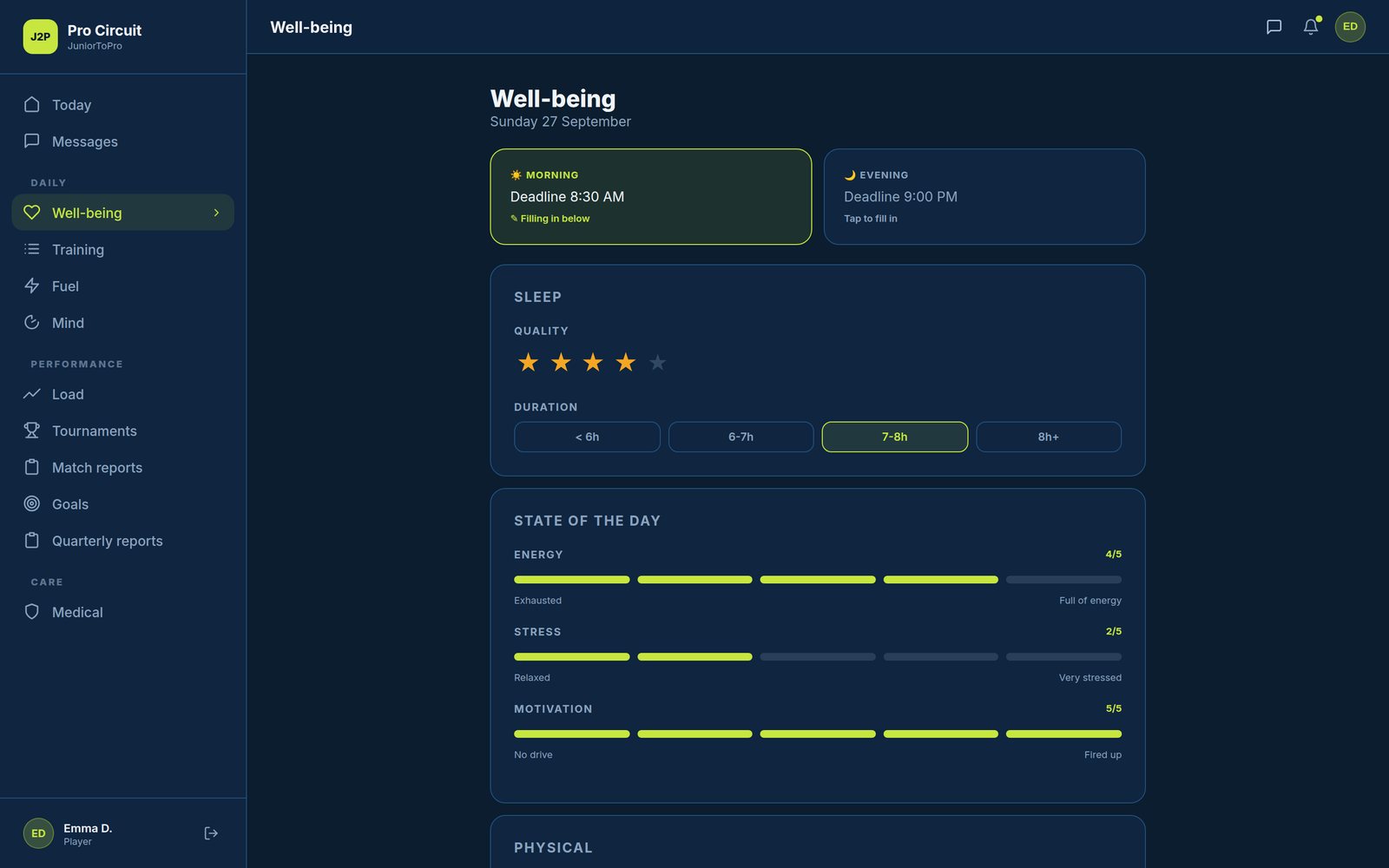
In J2Pro Circuit, the player completes a morning and an evening check-in, each with a deadline. It covers:
- sleep quality and duration;
- energy, stress and motivation;
- a physical section.
From these answers the app produces a Hooper score and a readiness level: green, yellow or red. The check-in appears in the player’s “Today” screen, alongside the rest of her day: physio protocol, on-court block, session feedback and refuel window.
For the staff, a team dashboard sorts the squad into ready, watch, alert and pending. The staff home screen answers one question — “who needs you today?” — showing wellbeing status, a load reading, red flags and missed check-ins, with actions to review or send a reminder. A missed check-in is itself information: players under pressure are often the ones who stop reporting.
What do we do when readiness is yellow or red?
A colour is the start of a decision, not the decision itself. My usual approach:
- Green: the planned session goes ahead.
- Yellow: we talk, and often adjust — shorter volume, lower intensity, more technical focus, or a recovery session instead of a hard fitness block.
- Red: we look for the cause. If it is sleep or travel, we lighten the day. If the physical section points to pain, the physiotherapist or doctor is involved, and training can be restricted through a medical flag in the app.
Load data help us here. Over time, J2Pro Circuit’s auto-calibration index learns each player’s own optimal weekly load range and personal risk threshold from load weeks paired with wellbeing data — so the wellbeing check-in also makes the load recommendations more personal.
Who sees the player’s wellbeing data?
Honest answers need trust. If a player fears that every bad night will be read by everyone, she will stop answering honestly — and the tool becomes useless. That is why privacy is built into J2Pro Circuit:
- The player controls sharing. By default, all staff attached to her can see her wellbeing entries. She can limit access to named people; she can only narrow access, never widen it.
- The head coach can never be excluded, so the person responsible for her programme always has the full picture.
- Parents see readiness only — the green, yellow or red level — never pain levels or free notes.
- Permissions are checked on the server, not only hidden in the interface, and a player only ever receives her own records.
For parents, this can feel frustrating at first. In my experience it works in their favour: a teenager who knows her private notes stay private is far more likely to report honestly, and the parent still sees the signal that matters — whether she is ready to train.
How to make the check-in a habit
- Keep it short. Under a minute, morning and evening.
- Same time every day. The morning check-in works best on waking, before breakfast.
- Close the loop. Players keep reporting when they see that their answers change something.
- No judgement. A red day is information, not a failure.
- Keep it going on tour. Tournament weeks, travel and time zones are exactly when the check-in matters most.
Wellbeing monitoring is part of a wider approach to the athlete that combines physical preparation, recovery and the mental side. Read more on our page about physical and mental training.
Read next: all J2Pro Circuit articles.
Frequently asked questions
What questions are in a tennis wellbeing questionnaire?
Typically sleep quality, stress, fatigue and muscle soreness — the four items of the Hooper index. The J2Pro Circuit check-in covers sleep quality and duration, energy, stress, motivation and a physical section.
Can a wellbeing check-in really prevent injuries?
It cannot guarantee that no injury will happen, but it gives early warning of fatigue, poor sleep and stress, so the team can adjust training before a small problem becomes an injury.
How often should a junior player complete a wellbeing check-in?
Every day. In J2Pro Circuit there is a morning and an evening check-in, each with a deadline, so trends can be seen across the week and during tournaments.
Can parents see their child’s wellbeing answers?
Parents see the readiness level only — green, yellow or red — never pain levels or free notes. The player controls which staff members can see her entries, and the head coach can never be excluded.
What happens if a player reports pain in the check-in?
The coach reviews it and involves the physiotherapist or doctor when needed. Training can be adjusted or restricted, but any medical decision is made by the medical staff.
Build the habit with your team
Discover how the daily check-in works in J2Pro Circuit, or book a call to discuss load and wellbeing monitoring for your player.