A tennis career is a small business with one employee, no guaranteed income and a very short window. Someone has to run it. In most families that job falls to a parent by default. A performance manager takes it on deliberately: the plan, the calendar, the budget, the staff and the data, so that the player can concentrate on becoming a better tennis player.
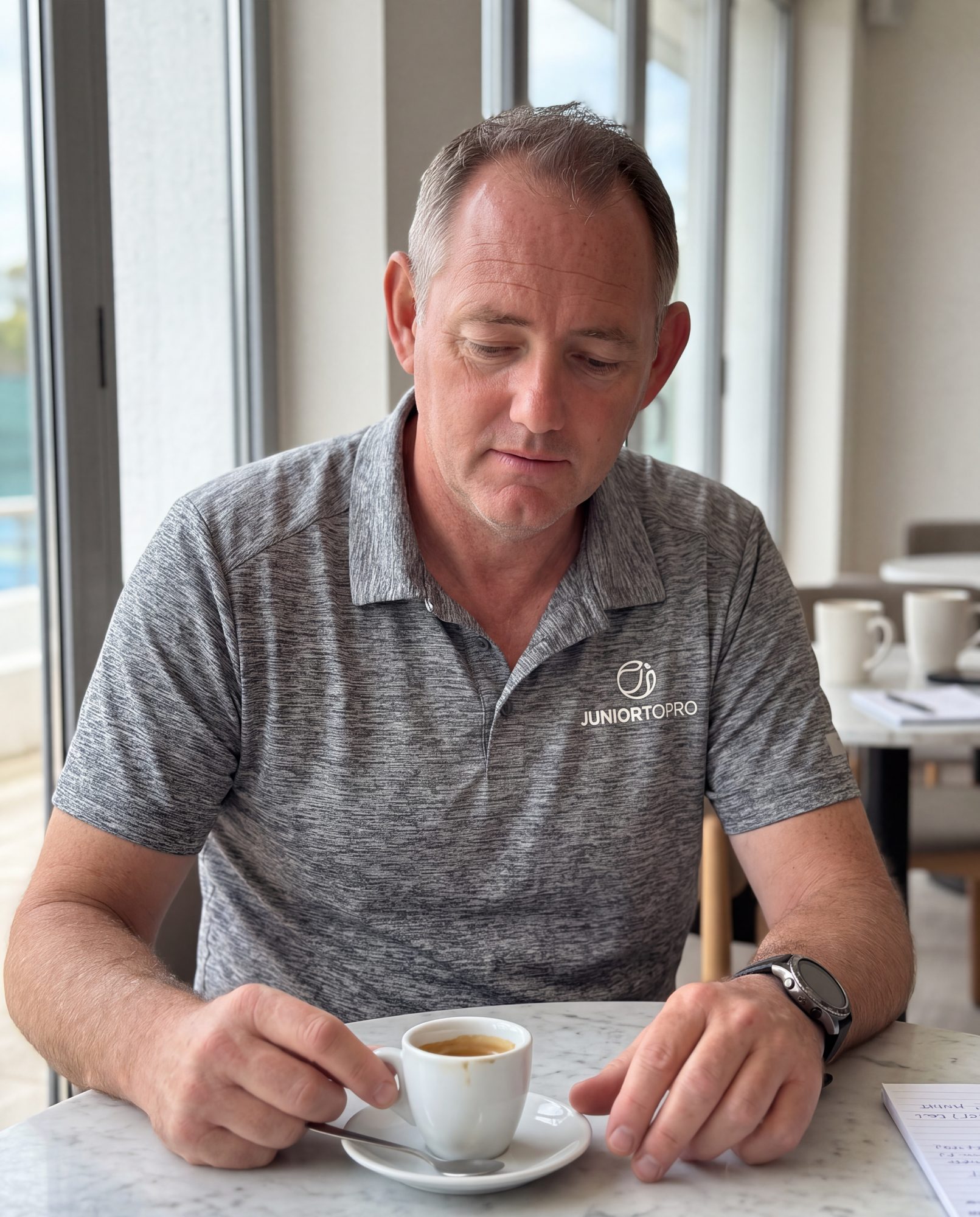
I am Geoffroy Dupuis, founder of JuniorToPro, GPTCA B-Level International Coach, holder of the French State diploma DEJEPS and of a Master’s in sports training. I am an independent high-performance tennis coach based in Montpellier, in the South of France, and I have coached at more than 50 professional and 70 junior tournaments on the Tennis Europe, ITF Junior, ITF World Tennis Tour and WTA circuits. Over the years I have seen talented players stall not because of their forehand, but because nobody was steering the project. This article explains what tennis career management really involves, and how to decide whether a player needs it.
What is tennis career management?
Tennis career management is the organisation of everything around a player’s tennis that affects her progress: season planning, tournament scheduling, budget, partners, staff, data and communication. If the coach is the pilot focused on the next flight, the performance manager is the flight operations centre, planning routes, fuel, crew and maintenance so that every flight is possible and safe.
In professional team sports, this work is spread across a whole club structure. In tennis, the player is the club. Unless someone owns these tasks, they are handled late, in a hurry, or not at all.
What is the difference between a coach, an agent and a performance manager?
The three roles overlap, but they answer different questions. Confusing them is one of the most common mistakes families make.
| Role | Main question | Typical focus |
|---|---|---|
| Coach | How does the player get better? | Technique, tactics, training, match coaching, day-to-day development. |
| Agent | How is the player’s commercial value developed? | Contracts, commercial deals, wild card and event relationships, often once the player already has a ranking or profile. |
| Performance manager | How is the whole project organised to make progress possible? | Annual plan, calendar, budget, staff coordination, data, reporting, partners and education. |
An agent typically becomes interested when there is already commercial value to manage. A junior at 15 or 16 rarely has that yet, but she already has a budget, a calendar and a staff to coordinate. That gap is exactly where performance management adds the most. In my work, the coaching role and the management role are combined: I build the plan and I am also on court and on the road to execute it.
What does a tennis performance manager actually do?
A performance manager turns a vague ambition (“she wants to turn pro”) into a plan with dates, costs and measurable checkpoints. In practice, the work covers eight areas.
1. Annual planning
The season is divided into blocks: preparation, competition swings, recovery and development phases. Each block has objectives on court and in the gym, and the calendar is built around them, not the other way round.
2. Tournament scheduling as an investment
Every tournament is priced and judged by its expected return: ranking points, level of opposition, surface experience and the chance of getting into the main draw. Events are grouped into swings to share travel and coaching costs. I explain this logic in detail in my article on tournament schedules as an investment strategy.
3. Budget
A realistic season budget, built as a range from early losses to deep runs, with funding sources identified in advance: family, sponsors, grants or prize money. The budget is reviewed as the season unfolds, not discovered at the end.
4. Sponsors, partners and equipment deals
Preparing a clear presentation of the project, identifying realistic local and brand partners, and handling racket, string, clothing and shoe arrangements. At junior level, these deals are usually modest, so the aim is professionalism and continuity rather than big numbers.
5. Staff coordination
A home coach, a fitness coach, a physiotherapist, a mental performance specialist, sometimes a school or university. The performance manager makes sure they share the same plan and the same information, so the player does not receive four contradictory messages.
6. Data and reports
Match statistics, training load, physical tests and ranking evolution collected in one place and turned into short, readable reports. Data is only useful if it leads to decisions.
7. Image and communication
A coherent, professional presence: a simple player profile, sensible social media habits, and preparation for interviews or partner communication. For minors, this includes protecting privacy and setting clear boundaries.
8. Education
Balancing school or distance learning with the tennis calendar, and keeping options open, including the US college route, so that the player’s future does not depend on a single outcome.
When does a junior tennis player need career management?
A junior needs structured career management as soon as her tennis decisions start to carry significant costs and consequences, usually when she begins travelling regularly for international events. In practice, that often means:
- Playing Tennis Europe or ITF Junior events abroad several times a year.
- Preparing the first entries on the ITF World Tennis Tour (W15, W35 events).
- Working with more than one staff member, such as a coach, a fitness coach and a physiotherapist.
- Talking to sponsors, equipment brands or university programmes.
- Parents spending more time on logistics and spreadsheets than on being parents.
If three or more of these apply, the project has outgrown improvised organisation. The junior-to-pro transition is the period where good management makes the biggest difference, because the costs rise sharply while income remains close to zero.
How do you choose a tennis career manager?
Choose someone who has lived the tour at the player’s level, who works with evidence, and who is transparent about money and conflicts of interest. Questions I would ask any candidate, including me:
- What is your experience at this level? Tennis Europe, ITF Junior and ITF professional events each have their own rules and realities.
- How do you plan a season? Ask to see a real (anonymised) plan with a calendar and budget range.
- What will I receive, and how often? Reports, meetings, access to data.
- How are you paid? Fixed fee, retainer or commission, and any commissions from third parties such as academies or brands.
- Who else do you work with? Look for clear rules if the manager handles several players at a similar level.
- Can I see results? Anonymised case studies are more useful than promises.
Red flags include guarantees about rankings or scholarships, fees that are unclear until after the season, and anyone who wants to isolate the player from her existing staff instead of coordinating with them.
How does JuniorToPro manage a player’s career?
At JuniorToPro, I combine coaching and career management in one system, supported by two tools I built because nothing on the market answered the questions I faced on tour. As a travelling coach based in Montpellier, South of France, I work with players from France and internationally, and the system is designed to work whether I am on site or following remotely.
J2Pro Circuit: daily monitoring
J2Pro Circuit is the app where the player, the family and the staff follow the season day by day: schedule, training and match load, wellness, match notes and tournament logistics. Everyone sees the same information, which removes a great deal of noise and misunderstanding.
J2Pro Planner: season and budget strategy
J2Pro Planner is my own planning tool, used for the players I coach and advise. It estimates entry chances for each tournament, prices each event as a cost range, shows euros per ranking point and net cost after prize money, and compares the points a player must defend with the points each plan is expected to bring.
Quarterly reports
Every quarter, the family receives a written report: progress against objectives, ranking and match data, physical indicators, budget spent versus planned, and the priorities for the next block. It is the equivalent of a board meeting for the project, short, factual and focused on decisions.
Frequently asked questions
What is the difference between a tennis agent and a performance manager?
An agent mainly develops a player’s commercial value through contracts and deals, usually once she has a ranking or profile. A performance manager organises the whole project, including planning, calendar, budget, staff and data, so that progress is possible in the first place.
At what age does a tennis player need career management?
There is no fixed age. The trigger is when tennis decisions start to carry significant costs, typically when a junior travels regularly for Tennis Europe or ITF Junior events or prepares her first professional tournaments.
Can a coach also be a player’s career manager?
Yes. Combining the two roles works well when the coach has experience at the player’s level and uses clear planning, budgeting and reporting tools. It keeps decisions consistent between the plan and what happens on court.
What does tennis career management include?
Annual planning, tournament scheduling, budgeting, sponsor and equipment arrangements, staff coordination, data and reporting, image and communication, and education planning.
How do I know if a career manager is right for my child?
Ask for experience at the right level, an anonymised example of a season plan and budget, a clear explanation of fees and commissions, and evidence of results. Avoid anyone who guarantees rankings or scholarships.
Read next: How Much Does a Travelling Tennis Coach Cost? · Tennis Is Expensive: Why Your Tournament Schedule Is an Investment Strategy
Give the project a structure
Take the free Tennis Pro Readiness test to see where your project stands, or book a call to discuss your season plan, budget and next steps with me.