
Two questions from an agent. Two reports. One clear plan.
A WTA-ranked player (around 630, career-high 316) lost in three sets at a W75 event to an opponent ranked around 420. Her agent asked two questions: what is really holding her back, and is there a fault in her serve? Here is how we answered both — with data, not impressions.
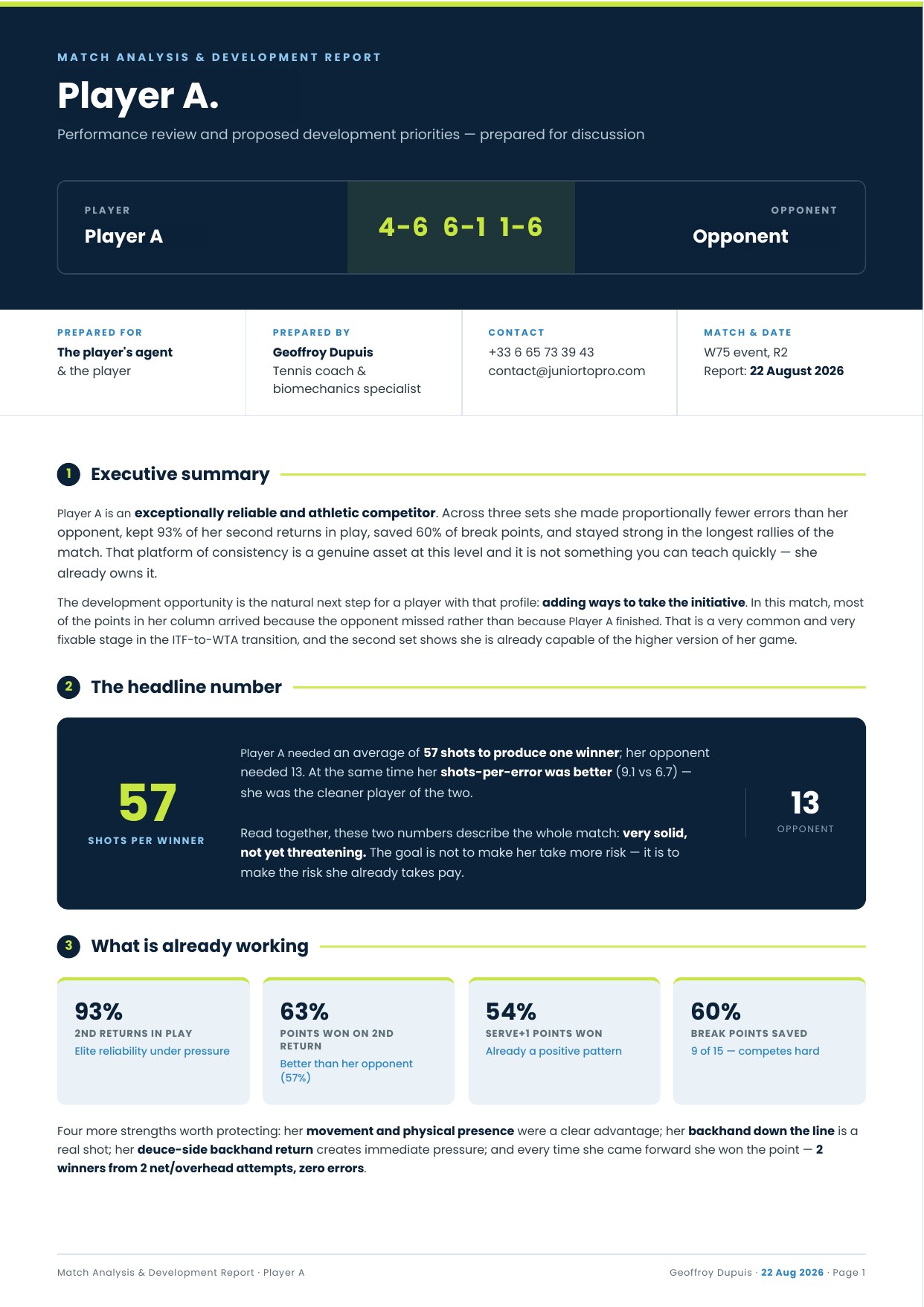
What is really holding her back?
Think of her game as a savings account with excellent security and no interest: nothing is lost, but nothing grows. The work is to add the interest without weakening the security.
57 shots per winner. Her opponent needed 13.
Yet she was the cleaner player: 9.1 shots per error against 6.7. Read together, these two numbers describe the whole match — very solid, not yet threatening. The goal was never to make her take more risk. It was to make the risk she already takes pay.
- 93% of second-serve returns in play
- 63% of points won on the second-serve return (opponent: 57%)
- 60% of break points saved — 9 of 15
- 2 winners from 2 net attempts, zero errors
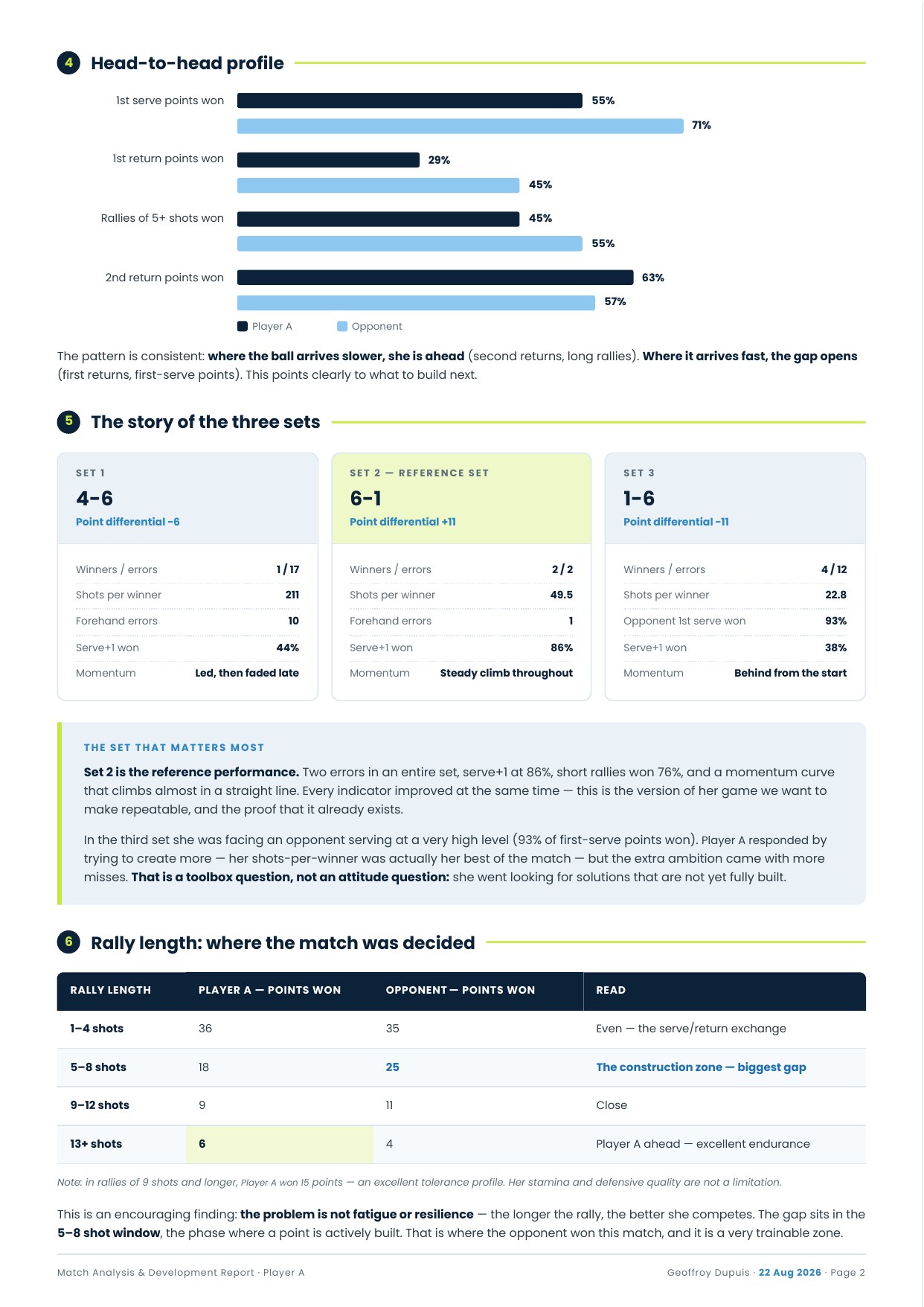
Not fitness. Not character. The 5–8 shot window.
Short points were even (36–35). Long rallies of 13+ shots went her way (6–4). The gap sat in the 5–8 shot window — the phase where a point is actively built — lost 18–25. That is a question of tools, and it is very trainable.
The second set proved it: only two errors in the whole set, serve+1 won at 86%, and six runs of three or four consecutive points. It became the reference performance — the version of her game to make repeatable.
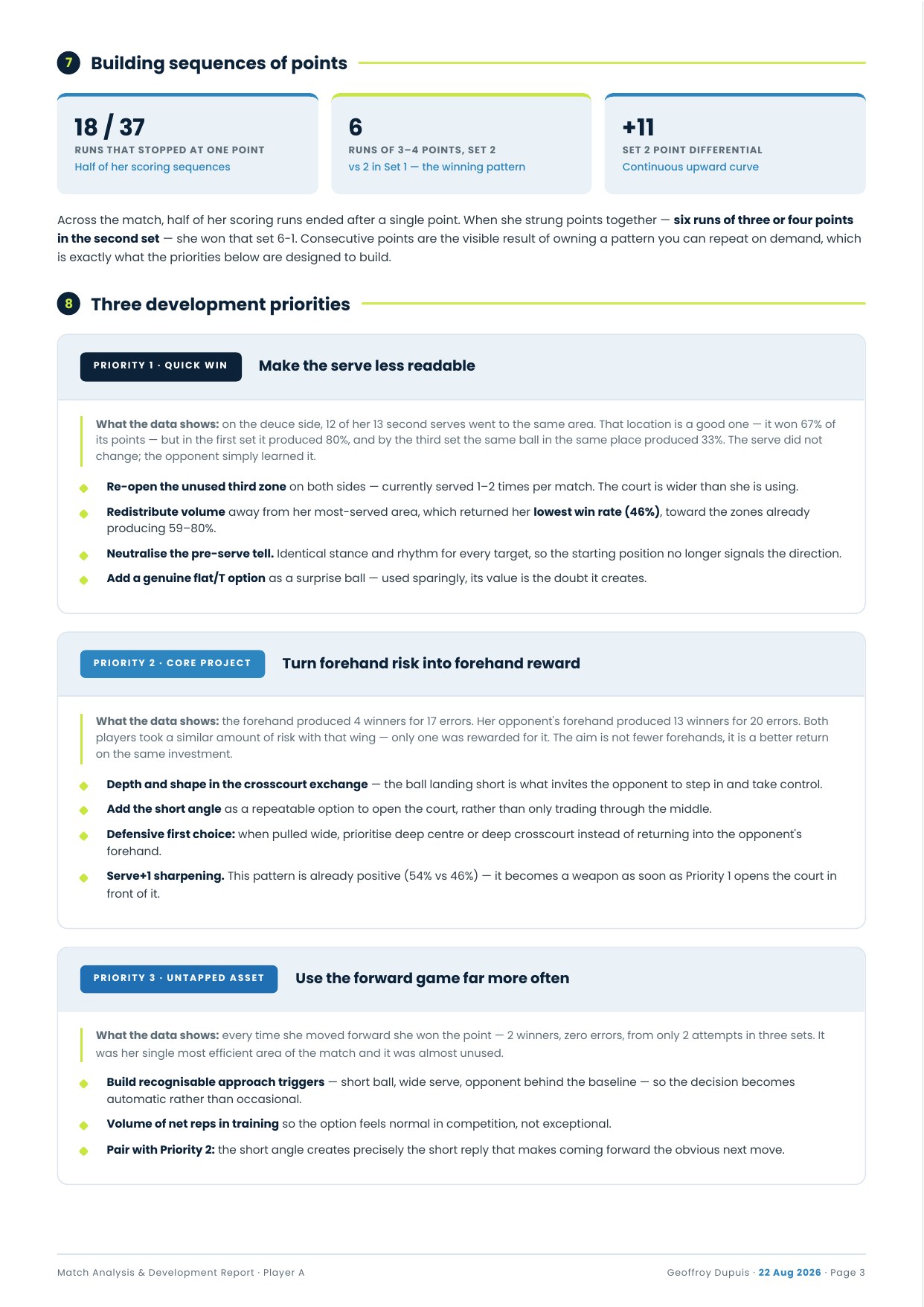
A quick win, a core project, an untapped asset.
- Make the serve less readable. On the deuce side, 12 of 13 second serves went to the same area: 80% of points won in set 1, 33% in set 3. The serve did not change — the opponent learned it.
- Turn forehand risk into reward. 4 winners for 17 errors, against 13 for 20 on the other side of the net. Same risk, different return.
- Use the forward game. Her most efficient area of the match, almost unused.
Is there a fault in the kinetic chain?
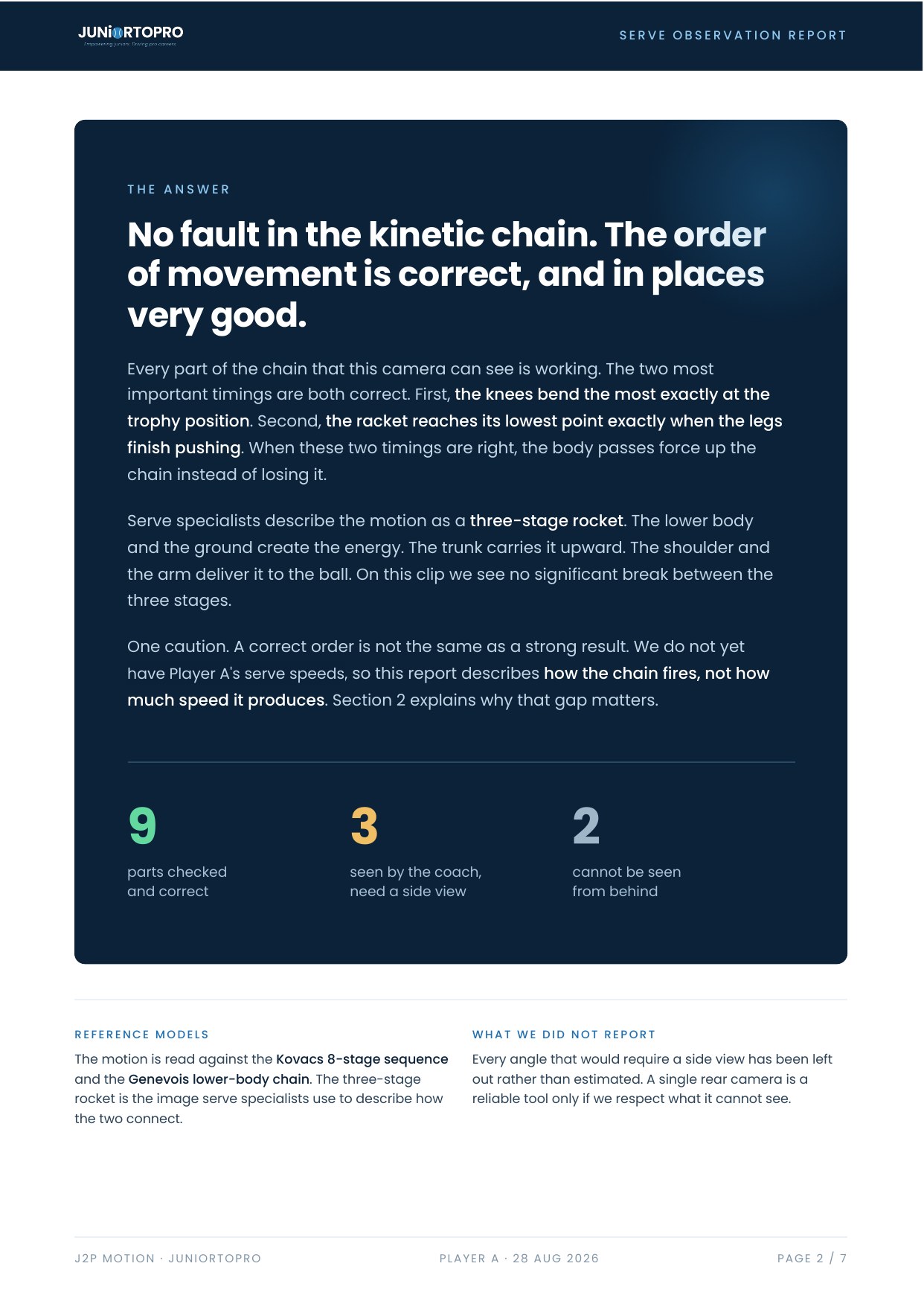
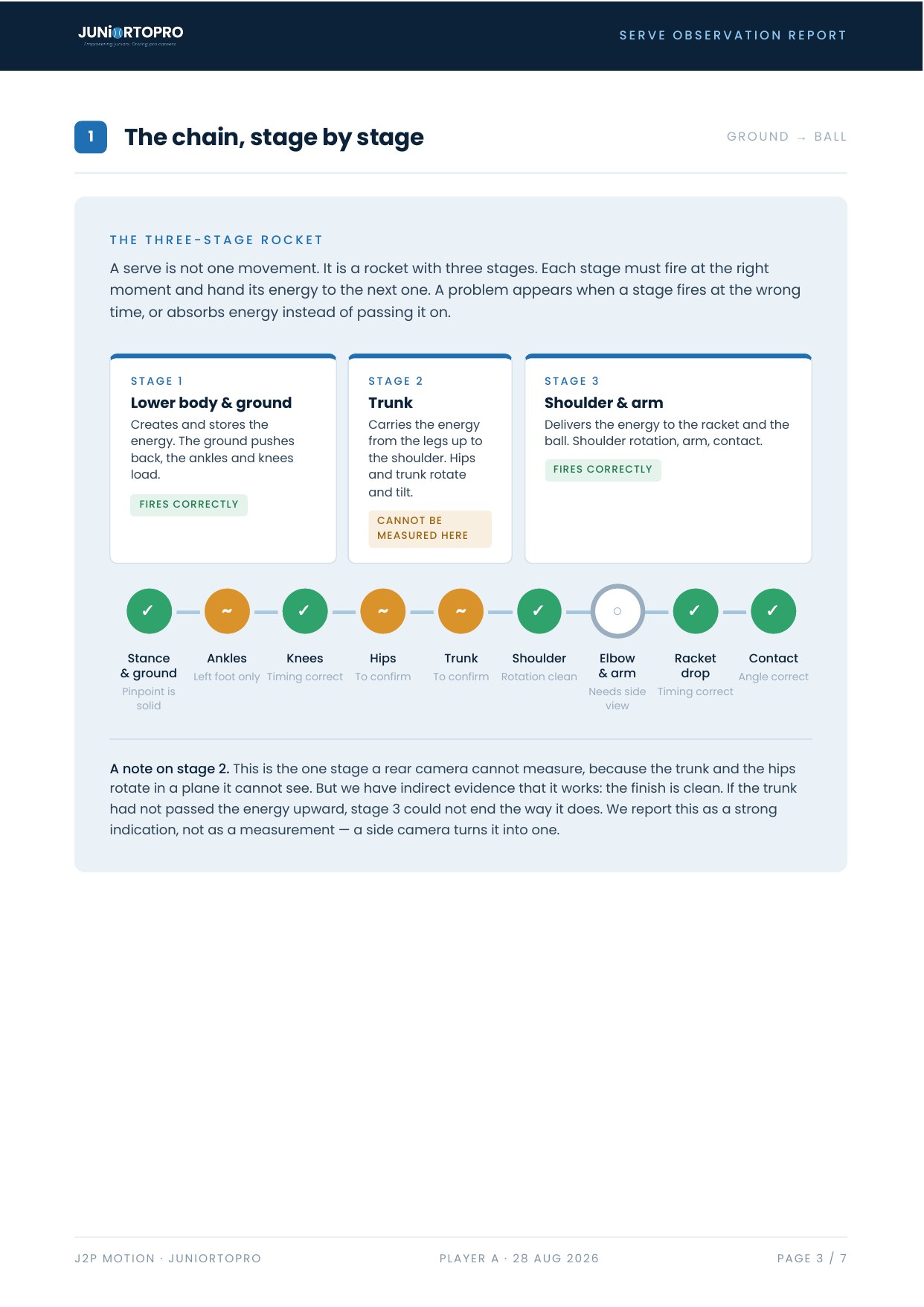
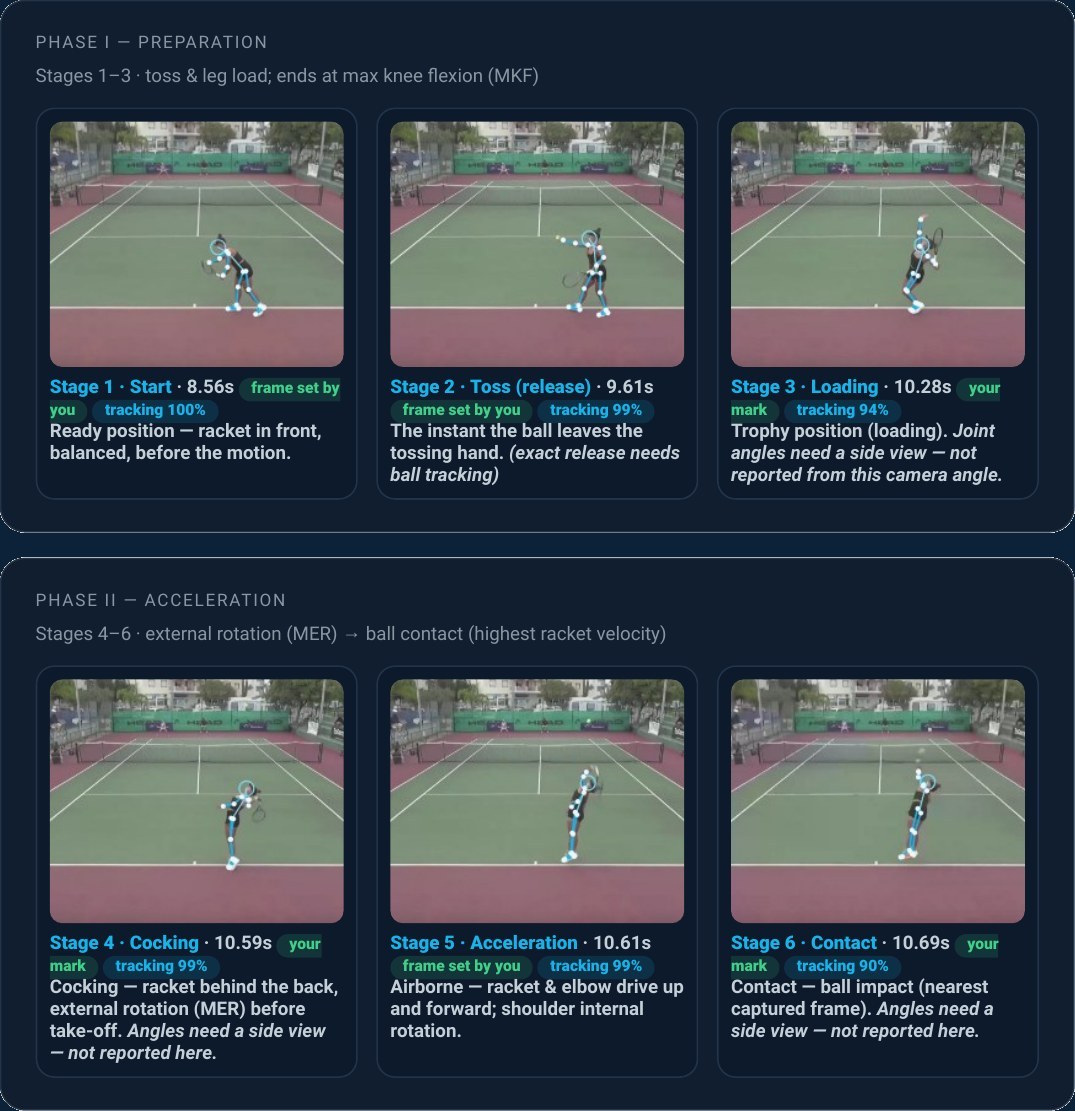
Think of the serve as a three-stage rocket: lower body, trunk, then shoulder and arm. Each stage must fire at the right moment and hand its energy to the next. The answer: no fault in the chain. Nine checkpoints confirmed correct, three reported as observations to confirm, two not reported because a single rear camera cannot see them.
A correct movement is not a strong result.
The two most important timings were right: the knees bend the most exactly at the trophy position, and the racket reaches its lowest point exactly when the legs finish pushing. So the report asked for the missing measurement before proposing any change: serve speeds with Baseline Vision.
- Speeds in range → the chain converts well; the technique stays untouched.
- Speeds below range → the order is right but the force is not; the work moves to leg power, ankle drive and trunk rotation, measured with Kinvent.
- Sequence agreed: serve placement first, measure speed, then build the forehand and the forward game — with training load monitored throughout.