
Every tournament week is a cheque written in advance. Flights, hotels, meals, entry fees and coaching are paid before the first ball is struck, and the return, ranking points, match experience and prize money, is never guaranteed. Families who treat the tournament schedule as an investment portfolio rather than a wish list get further on the same budget.
I am Geoffroy Dupuis, founder of JuniorToPro and an independent high-performance coach based in Montpellier, France. I work with players on the ITF Junior Tour, the ITF World Tennis Tour and the WTA. The single most expensive mistake I see is not a technical flaw or a tactical one. It is a badly built calendar: the wrong events, in the wrong order, in the wrong places. This article explains why the schedule deserves the same rigour as any financial decision, and how I plan it with the players I coach.
Why is professional tennis so expensive?
A footballer’s club pays for the team bus; a tennis player pays for her own flights, her own hotel, and often her coach’s travel as well. On the ITF World Tennis Tour, where most women begin their professional careers (W15, W35, W50, W75 and W100 events), prize money at the lower levels rarely covers the cost of the week for players who lose early.
The main cost lines are always the same:
- Travel: flights or long drives, plus local transfers between airport, hotel and club.
- Accommodation and meals: the longer you stay in the draw, the more nights you pay for, unless the event provides hospitality.
- Entry fees: modest per event, but they add up over a season.
- Coaching: a coach’s fee per day on site, plus the coach’s own travel and accommodation.
None of these lines is unusual on its own. What makes tennis expensive is that they repeat every week, for 20 to 30 weeks a year, with no guaranteed income on the other side.
What does it mean to treat a tournament schedule as an investment?
Think of a season as a portfolio. Each tournament is a position you open: you commit capital (the cost of the week) in exchange for an expected return (ranking points, development and experience) with a known level of risk (a first-round loss is always possible). A good investor does not buy a share because it is famous or close to home. She asks three questions: what will it cost, what can it return, and how does it fit with everything else I hold?
Applied to tennis, that means asking of every event:
- Can I get in? A tournament you cannot enter, or can only enter through a long qualifying draw, has a very different expected return from one where you are safely in the main draw.
- What will it really cost? Not the optimistic figure. The range, from a first-round loss to a run to the final.
- What can it return? Ranking points, yes, but also the quality of opposition and the surface experience the player needs for her project.
- How does it connect? An event that chains naturally with the week before and the week after is cheaper than an isolated trip.
How much does a week on the ITF World Tennis Tour cost?
There is no single answer, because costs vary with the country, the travel distance, whether a coach travels and how long the player stays in the draw. What I can show is the logic, with round numbers. The following is an illustrative example, not an official figure.
In this example, a player travels to a W15 event with a coach for one week:
- Return flights for two: €600
- Hotel, six nights: €480
- Meals: €300
- Coach fee, six days: €1,200
- Entry fee and local transfers: €150
In this example the total is about €2,730. If the player loses in the first round and leaves early, the bill may drop to around €1,900. If she reaches the final and stays the full week, it may rise above €3,000. That spread is the first thing a family needs to see, because a budget built on the optimistic case runs out halfway through the season.
Why a low price per tournament can still be bad value
Here is where the investment analogy really helps. The cheapest tournament is not automatically the best one, just as the cheapest share is not automatically the best buy. What matters is the cost per unit of return. In tennis, the simplest version of that is euros per ranking point.
A tournament that costs €1,500 but where the player is likely to lose in qualifying may return almost nothing. A tournament that costs €2,500 where she is comfortably in the main draw and can realistically win two or three rounds may be far better value. I explore this in detail in Points per Euro: Choosing the Right Tournaments.
But points alone are a trap. A player can collect points by repeatedly playing weak fields far from her level, a habit often called “points farming”. Her ranking rises for a while, but her game does not, and the bill arrives later when she steps up a category and is not ready. A good schedule balances points with development.
How I plan schedules with J2Pro Planner
I built J2Pro Planner because no tool on the market answered these questions in one place. It is my own planning tool, used for the players I coach; it is not sold separately. It sits alongside J2Pro Circuit, the app where the player, family and staff follow the season. The Planner covers the 2026 calendars of the ITF Junior Tour, the ITF World Tennis Tour, the WTA, the ATP, the ATP Challenger and the UTR Pro Tennis Tour. Here is what it brings to the investment question.
An entry radar based on real cut-offs
For each tournament the Planner shows whether the player is likely to get into the main draw directly, go through qualifying or need a wild card. It does this using the real 2025 entry cut-offs for each event.
Cost ranges, not single numbers
Each tournament shows a low–high cost range, from an early exit to a deep run, built from the coach’s day rate, the number of days on site, the type of accommodation, meals, entry fees and transfers. Where ITF hospitality applies, the rules by category and round are taken into account.
Euros per point and net cost
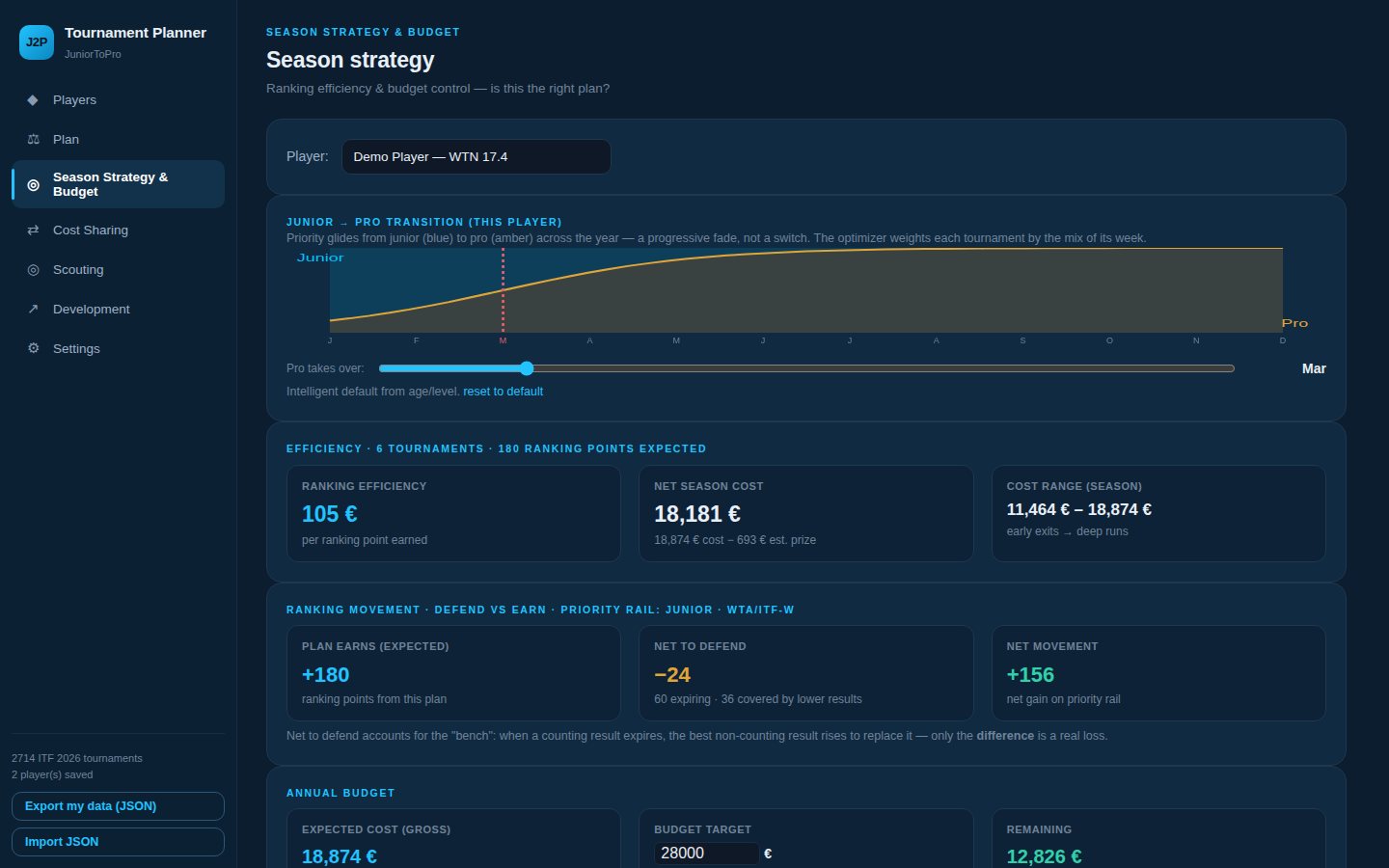
The Season Strategy & Budget view shows the euros spent per ranking point, event by event and for the whole season, and the net cost after estimated prize money. It also shows spending by coach, lodging, meals, entry and transport, and tracks the budget target against what remains.
Development, not just points
A development index corrects for points farming. It rewards dense, challenging fields and surfaces that matter for the player’s long-term project. I can also move a slider in the player’s profile between “ranking first” and “development first”, depending on where she is in her career.
Defend versus earn
WTA and ITF ranking points expire after 52 weeks. The Planner compares the points that will drop off with the points each new plan is expected to bring, so a family can see whether a season is actually moving the ranking forward or simply standing still at great expense.
Who benefits from this approach?
- ITF Junior players mixing junior events with their first W15s.
- Players in the junior-to-pro transition stretching a limited budget across a professional season.
- Parents and sponsors, because the Planner records dated funding credits and shows how they reduce the net cost.
Scheduling is one part of the wider tennis career management I provide, and it feeds directly into my junior-to-pro tennis coaching programme.
What should families do before building next season’s calendar?
- Write down the real budget, including what can be raised from sponsors or grants.
- List the objectives: a ranking target, a surface to master, a first professional title, a place in a Junior Grand Slam.
- Audit the last 12 months. Which trips could have been chained together? Which events were far below or far above the player’s level? The Planner’s 12-month scheduling audit does this automatically when I assess a new player.
- Price every event as a range, never as a single optimistic number.
- Group events into swings to share flights and, where possible, share a coach with another player.
For a practical walk-through of these steps, read How to Plan a W15–W35 Season on a Budget.
Frequently asked questions
Why is a tournament schedule an investment decision?
Because every tournament costs money up front and returns uncertain value: ranking points, development and prize money. Comparing cost against expected return, event by event, is exactly how an investor assesses a portfolio.
What is the most common scheduling mistake?
Choosing events one at a time, based on habit or proximity, without looking at entry chances, total cost ranges and how trips connect. Isolated trips and events far from the player’s level waste the most money.
Do ranking points last forever?
No. WTA and ITF ranking points count for 52 weeks and then drop off. A season plan must account for the points a player has to defend, not only the points she hopes to add.
Can I use J2Pro Planner myself?
J2Pro Planner is my own tool, used for the players I coach and advise. It is not sold as a separate product. You can read about it on the J2Pro Planner page.
Is a cheaper tournament always better for a limited budget?
No. A cheap event where the player is likely to lose in qualifying may cost more per ranking point than a more expensive event where she is safely in the main draw. Value depends on cost and expected return together.
Read next: How to Plan a W15–W35 Season on a Budget · Points per Euro: Choosing the Right Tournaments
Build a season that pays back
Take the free PRI-360™ Pro Readiness test to see where your project stands, or book a call to review your tournament schedule and budget with me.