
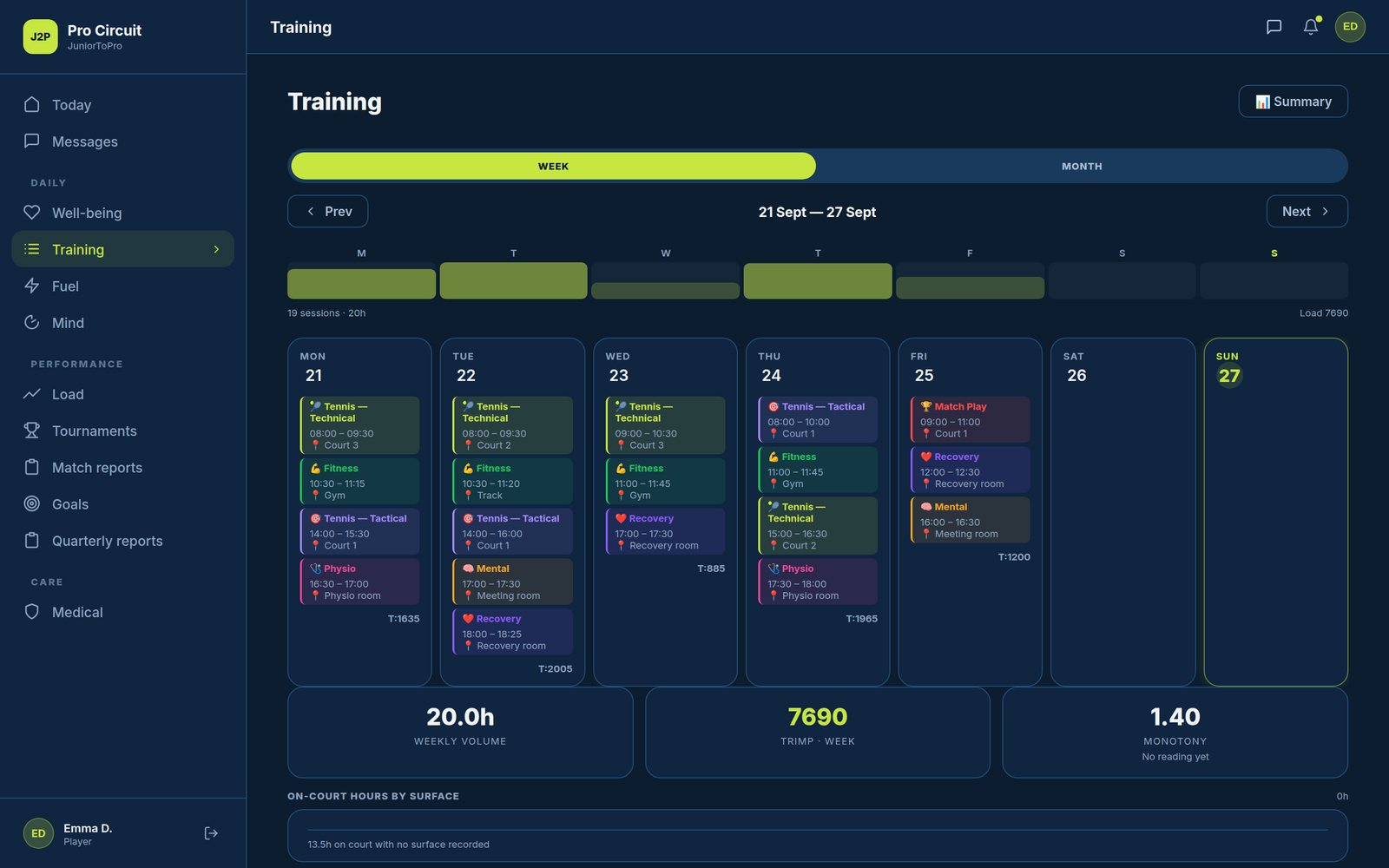
“How much is too much?” is the question every tennis parent asks during a heavy block or a tournament week. Training-load indicators do not give a magic answer, but they turn a feeling into a number the whole team can discuss.
I am Geoffroy Dupuis, founder of JuniorToPro, an independent high-performance coach working with players on the ITF Junior Tour, the ITF World Tennis Tour and the WTA. With every player I coach, training load is tracked day by day in our J2Pro Circuit app. Parents often hear the words TRIMP, ACWR, monotony and strain without anyone explaining them. This guide does exactly that, in plain language, with simple examples — and with an honest word about the limits of each number.
What is training load in tennis?
Training load is the amount of stress a player’s body and mind absorb from practice, fitness work and matches. It has two sides:
- External load: what the player does — minutes on court, number of serves, distance covered.
- Internal load: how hard it was for that player on that day — the physiological and mental cost.
The same 90-minute session can be easy for a rested 18-year-old and exhausting for a 15-year-old who slept badly after a long journey. That is why, in tennis, we pay close attention to internal load.
What is session RPE and TRIMP?
The most practical way to measure internal load is the session-RPE method described by Carl Foster. About 30 minutes after a session, the player rates how hard the whole session felt on a scale from 0 (rest) to 10 (maximal). That rating is multiplied by the session duration in minutes:
Session load = RPE × minutes
In J2Pro Circuit this value is shown as TRIMP (training impulse), calculated as RPE × minutes. A 90-minute practice rated 6 gives 540 units; a 60-minute recovery session rated 3 gives 180 units. The units themselves have no meaning on their own — like points on a loyalty card, they only become useful when you add them up and compare them over time.
Why a simple rating? It works for every type of session and captures what heart-rate data cannot: the mental cost of a tense match.
What is training monotony?
Monotony measures how similar the days of a week are. It is calculated as:
Monotony = mean daily load of the week ÷ standard deviation of daily load
Think of it like a diet. Eating the same heavy meal every day is harder on the body than alternating big days and light days, even when the weekly total is the same. The same goes for training: a week with clear hard days, easy days and rest days has low monotony; a week where every day is “medium-hard” has high monotony.
A simple example. A 16-year-old player trains Monday (360 units), Tuesday (450), rests on Wednesday, then trains Thursday (525), Friday (240) and Saturday (540), and rests on Sunday. The weekly total is 2,115 units, the daily mean is about 302, and the variation between days is large — monotony comes out at around 1.4. Now imagine the same player doing roughly 400 units every single day with no rest day: the variation almost disappears and monotony shoots up. In practice, values above about 2 are often treated as a warning sign, but the trend for each player matters more than any single threshold.
What is training strain?
Strain combines volume and monotony:
Strain = weekly load × monotony
It answers a simple question: is this week both big and repetitive? A heavy week with good variation can be perfectly acceptable. A heavy week with no variation is the combination we watch most closely, because the body gets little opportunity to recover between efforts. In the example above, strain would be about 2,115 × 1.4, so roughly 3,000 units.
What is the ACWR (acute:chronic workload ratio)?
The ACWR compares what the player has done recently with what her body is used to:
- Acute load: the load of the last 7 days — the “fatigue” side.
- Chronic load: the average weekly load over the last 28 days — the “fitness” side, what the body has been prepared for.
ACWR = acute load ÷ chronic load
An analogy I use with parents: chronic load is the size of the fuel tank the player has built; acute load is how much fuel she is burning this week. If a player has averaged 2,000 units per week over the last month and does 2,400 this week, her ACWR is 1.2 — a moderate increase. If she suddenly does 3,600, the ratio jumps to 1.8: she is burning far more than her tank was built for.
What is a good ACWR?
A range of about 0.8 to 1.3 is commonly discussed as a “sweet spot”: high enough to keep progressing, without sudden spikes. Well below 0.8 can mean the player is losing fitness (after a break, for example); well above 1.3 means the load has risen quickly compared with what she is used to.
But this range is a guide, not a rule. The ACWR has real scientific limitations: researchers have questioned how it is calculated (rolling averages versus other methods), the statistical link between the acute and chronic parts of the ratio, and how strongly it predicts injury on its own. I use it as one warning light on the dashboard, never as the only one — and always alongside the player’s wellbeing and what I see on court.
Why do tennis players need load monitoring?
Tennis makes load hard to control. The tournament calendar does not care about periodisation: a player can lose in the first round on Monday and have an empty week, or win five matches in qualifying and main draw and play almost every day. Add travel and school, and sudden spikes become likely.
Load monitoring helps the team to:
- spot rapid increases before they turn into overload;
- plan lighter days after a long tournament run;
- make sure the week has real variation, not the same medium-hard session every day;
- protect growing juniors, whose bodies are changing quickly.
Load is only half of the story. The other half is how the player is responding, which is why load always sits next to a daily wellbeing check-in. I explain that side in “Why a daily wellbeing check-in prevents injuries”. For the recovery side of the equation, read our guide to recovery as invisible training.
How does J2Pro Circuit track training load?
In J2Pro Circuit, the player rates each session with RPE in the training calendar. The Load module then shows weekly volume, TRIMP, ACWR, monotony and strain, split by session category and by surface.
The app also has an auto-calibration index. Over time, it learns each player’s own optimal weekly load range and personal risk threshold, from the load weeks paired with her wellbeing data. From there it proposes peak, standard and recovery scenarios for the coming week. This matters, because a generic range fits no one perfectly: two players of the same age can tolerate very different loads.
What do parents see?
Privacy is built into the app. A parent invited to J2Pro Circuit sees the player’s readiness only — never pain levels or free notes — plus the tournament calendar, match reports, quarterly reports and messages with the coach. The detailed load and wellbeing data are handled by the staff, and the player herself controls who among the staff can see her wellbeing entries, within one rule: the head coach can never be excluded.
What should parents do with these numbers?
- Ask about trends, not single days. One high session is normal; three weeks of rising strain is a conversation.
- Encourage honest RPE. The whole system depends on the player rating sessions truthfully, without trying to look tough.
- Respect rest days. An extra “quick hit” on a rest day raises monotony more than families realise.
- Talk to the coach. Numbers start the discussion; they do not end it.
Read next: all J2Pro Circuit articles.
Frequently asked questions
How is TRIMP calculated in tennis?
With the session-RPE method: the player rates the session from 0 to 10 about 30 minutes after it ends, and the rating is multiplied by the duration in minutes. A 90-minute session rated 6 gives 540 units.
What is a good ACWR for a tennis player?
A range of roughly 0.8 to 1.3 is commonly discussed as a sweet spot. It is a guide, not a rule: the ACWR has known scientific limitations and should always be read alongside wellbeing data and the coach’s observations.
What does high training monotony mean?
It means the days of the week are too similar, with little difference between hard and easy days. Monotony is the weekly mean daily load divided by its standard deviation; values above about 2 are often treated as a warning sign.
What is the difference between monotony and strain?
Monotony describes how repetitive the week is. Strain multiplies the weekly load by monotony, so it rises when a week is both heavy and repetitive.
Can parents see their child’s training load in J2Pro Circuit?
Parents see readiness only, never pain or free notes, plus the tournament calendar, match reports, quarterly reports and messages with the coach. Detailed data stay with the player and her staff.
Talk about your player’s load
Discover J2Pro Circuit, or book a call to discuss how we plan and monitor training load across a tournament season.