Filming a serve is easy. Turning what the video shows into a training plan that actually changes the serve — and keeps the change under pressure — is where most technical work succeeds or fails.
I am Geoffroy Dupuis, founder of JuniorToPro, an independent high-performance coach working with players from the ITF Junior Tour to the ITF World Tennis Tour and the WTA. Over the years I have seen many players with hours of video on their phones and no clear idea of what to do with it. Video without a method is like a medical scan without a doctor to read it: interesting, but not useful. This article describes the five-step process I use with J2Pro Motion to go from a slow-motion video to a technical plan, and back to a new measurement.
Why does video alone rarely change a serve?
Watching yourself serve is a good start, but it has three limits. First, the eye is too slow: the key events of the serve — the racket drop, the leg drive, contact — happen in fractions of a second. Second, the eye is drawn to the symptom (the ball goes long, the arm looks tense) rather than the cause further down the chain. Third, without a clear priority, the player tries to fix everything at once.
A structured process answers these three problems: it slows the serve down, it follows the kinetic chain from the legs to the racket, and it forces a choice of two or three priorities.
Step 1 — How do we film the serve?
We film a slow-motion side view of three to five serves, one serve per video, in training or in match conditions. A phone is enough. J2Pro Motion accepts footage from 30 to 960 fps; 240 fps is ideal, and 480–960 fps gives an even finer view of contact. The player must be fully in frame.
Before the analysis, the tool asks for the player’s dominant hand, height, stance, serve type and frame rate. Optionally, we add a scale calibration and a Baseline Vision session summary so the technical picture sits next to the ball-tracking context of the session.
Filming in match conditions is often more revealing than a calm practice. A serve that looks clean in an empty court at 10 a.m. can change shape in a tight first round. When possible, I film both.
Step 2 — How is the serve analysed?
The analysis follows the 8-stage serve model of Kovacs & Ellenbecker, grouped in three phases: preparation, acceleration and follow-through. I anchor three key positions myself on the video — Loading · Trophy, Cocking and Contact (stages 3, 4 and 6) — and the tool measures the stages and the kinetic chain around them.
The video is analysed on the device; nothing is uploaded. For families of junior players, this matters: the footage stays private.
Think of this step as a mechanic listening to an engine with the bonnet open. We are not yet deciding what to change; we are finding where the energy is produced, where it is transferred cleanly and where it leaks.
Step 3 — What goes into the report?
The report gathers the results in eight sections: serve overview, footwork and trophy-position load, lower-body chain, upper-body chain, metrics table, strengths and priorities, session outcomes and setup notes. Each section is linked to its scientific reference (Martin; Genevois and Reid; Matsuo and Hernández-Davó), so the player, the family and the staff can see why a priority matters. I explain each section in detail in “What a serve biomechanics report shows”.
The two sections that drive the training plan are strengths and priorities and session outcomes. The first says what to keep and names the two or three changes that matter most. The second turns them into concrete targets for the next sessions.
How do we choose the priorities?
I use three filters:
- Cause before symptom. If the contact point is low because the legs do not drive, we work on the legs first. Fixing the arm would only move the problem.
- Protection before speed. A position that loads the shoulder at the trophy position takes priority over a few extra kilometres per hour, especially with a growing junior.
- Consistency before perfection. The consistency report shows the mean and the spread over 3 to 5 serves. A stage with a large spread is often a better target than a stage that is consistently “not ideal” but stable.
Step 4 — How does the report become training?
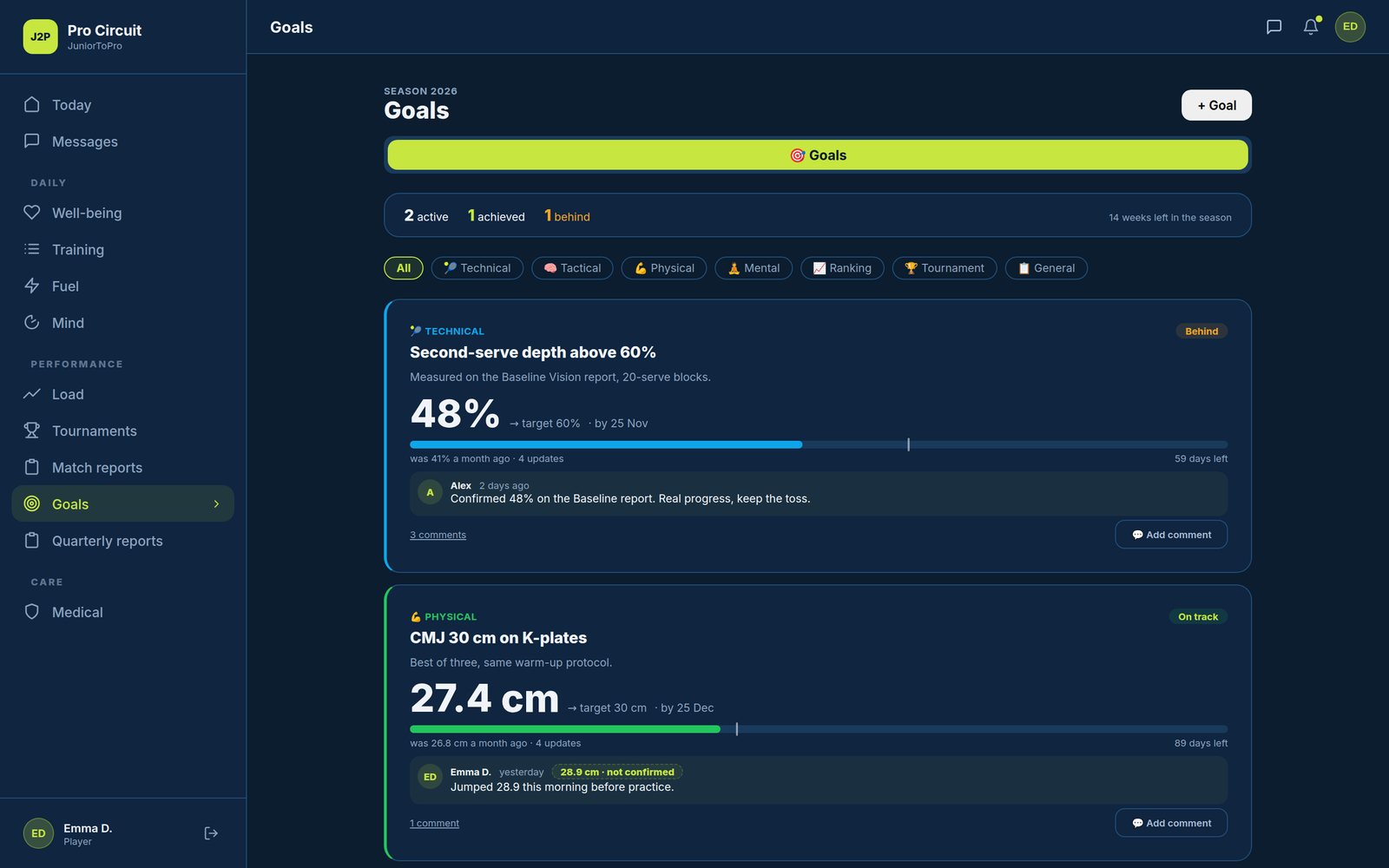
This is where the analysis earns its value. The priorities become measurable goals in the player’s J2Pro Circuit app. Each goal has a target, a measured current value, a deadline and an on-track or behind status, and the progress log separates values the player reports from values I confirm as coach. The sessions themselves are planned in the training calendar, with the technical block sitting next to the fitness, physio and recovery work of the week.
A typical technical plan combines three layers:
On-court technical work
Short, focused serve blocks built around one priority at a time — for example, the timing of the leg drive, or the racket drop at the cocking stage. Volume is kept moderate: serving is demanding for the shoulder, and quality matters more than quantity.
Physical work that supports the technique
A technical change often needs a physical foundation. If the legs are not producing force, a cue on court will not be enough. This is where I use Kinvent tools: K-Plates for force and jump profiles, K-Move for movement and speed measures, and K-Grip for grip strength. The fitness work is chosen to serve the serve, not in isolation. For the wider picture, see our page on physical and mental training.
Transfer to match conditions
A new movement is fragile. It has to be tested in points, then in practice matches, before it can be trusted in a tournament. I often use reaction and decision drills with Blazepod lights to add pressure and variability before match play.
Everything is connected: the load of these sessions is tracked through session RPE, so the extra serve work does not quietly push the weekly load too high. Technical ambition must fit inside a sensible training load.
Step 5 — How do we know the change has worked?
We re-test. A new J2Pro Motion analysis, filmed in the same conditions, shows whether the change holds across repetitions. We compare the mean and the spread of the key measurements with the first report.
Three outcomes are possible:
- The change holds: the mean moves in the right direction and the spread stays small. We confirm the goal and move to the next priority.
- The change appears but is unstable: the mean improves, but the spread grows. The movement is still being learned; we keep the priority and add repetition under pressure.
- Nothing changes: we revisit the diagnosis. Perhaps the true cause is elsewhere in the chain, or a physical limitation needs more time.
This loop — film, analyse, report, train, re-test — is what turns biomechanics from an interesting picture into a coaching method. You can read more about the approach on our tennis biomechanics page.
A practical example
Take a 16-year-old player whose serve often lands long under pressure. On video, the arm looks rushed. The report shows something else: a shallow knee bend at the trophy position and a leg drive that starts late, with a large spread across the five serves. The priority is therefore not the arm but the lower-body chain. The plan combines leg-drive timing on court, lower-body force work measured on K-Plates, and a gradual return to serving in points. Six weeks later, a new analysis shows whether the timing has stabilised. The arm, in many such cases, calms down on its own once the legs do their job.
Read next: all J2Pro Motion articles.
Frequently asked questions
How long does it take to change a serve technique?
It depends on the player, the change and the physical foundations. What matters is that the change is re-tested: it only counts when a new analysis shows it holds across 3 to 5 serves, not after one good session.
How many technical priorities should a player work on at once?
Two or three at most, and usually one per training block. A J2Pro Motion report deliberately limits its priorities, because trying to change everything at once rarely changes anything.
Do I need special equipment to film my serve?
No. A phone filming in slow motion from the side is enough. 240 fps is ideal; J2Pro Motion accepts 30 to 960 fps and adapts the report to the camera view.
Can I buy J2Pro Motion as an app?
No. J2Pro Motion is the biomechanics tool I use in my coaching work; it is not sold as a separate app. The report feeds the player’s goals and sessions in J2Pro Circuit.
How often should the serve be re-analysed?
After each training block focused on a priority, so the new analysis can confirm whether the change holds. The timing is set with the player according to the tournament schedule.
Turn your serve into a plan
Discover how J2Pro Motion works, or book a call to plan a serve analysis and a technical programme, in Montpellier or on tour.