
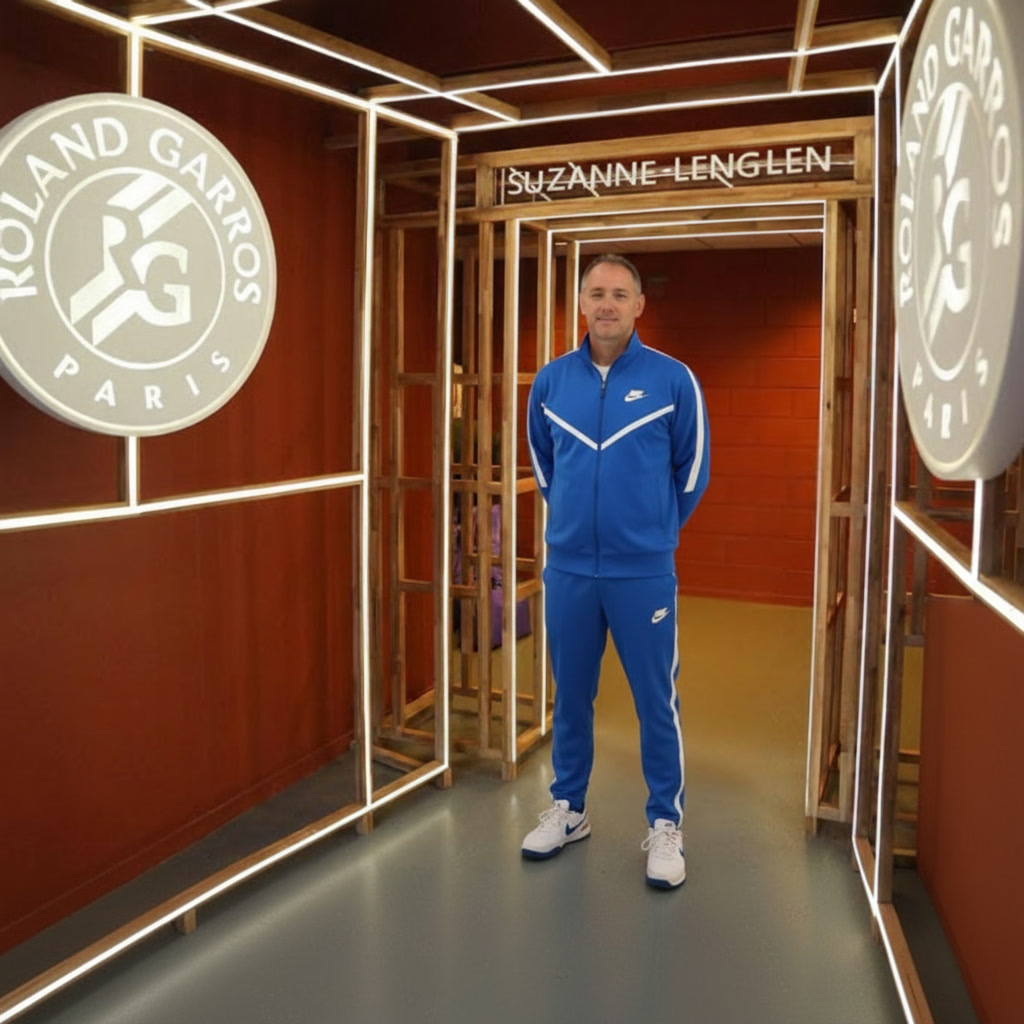
A travelling tennis coach is the one person who stays with the player from the first practice of the week to the last point of the tournament. On the ITF Junior Tour, the ITF World Tennis Tour and the WTA, that role decides far more matches than most families realise.
I am Geoffroy Dupuis, founder of JuniorToPro and an international travelling tennis coach based in Montpellier (France). For more than 20 years I have coached on the road: 50+ professional tournaments and 70+ junior tournaments across Europe, North Africa and beyond. This guide explains what a high-performance travelling coach actually does, what it costs a player not to have one, and how to choose the right person for an ITF or WTA project.
What is a travelling tennis coach?
A travelling tennis coach (also called a touring coach or tour coach) is a high-performance coach who accompanies a player to international tournaments and manages everything that influences performance during the competition week: practice planning, match preparation, scouting, recovery, logistics and emotional management.
It is different from a club or academy coach. An academy coach sees the player on the practice court. A travelling coach sees the player at 7 a.m. before a qualifying match in an unknown city, after a three-set loss, and during the long evenings between rounds. That is where careers are built — or lost.
Who needs a travelling coach?
- Tennis Europe players (U14–U16) starting their first international seasons.
- ITF Junior players (J30 to J500 and Grand Slam juniors) building a ranking that opens doors to the professional tour.
- Players in the junior-to-pro transition entering ITF World Tennis Tour events (W15, W35, W50, W75, W100 and the men’s equivalents).
- WTA and ATP players who need a dedicated coach on the road for a block of tournaments or a full season.
What a high-performance travelling coach does, day by day
1. Before the trip: planning the tournament schedule
The schedule is the first tactical decision of the season. I build it with the family around three questions: which surface develops the player’s game identity, which events give a realistic chance of ranking points, and how much travel the body can absorb. Every event is visible to the whole team in our J2Pro Circuit app.
2. On site: practice, scouting and match preparation
- Short, high-quality sessions adapted to the local surface, balls and altitude.
- Opponent scouting (video, statistics, previous results) and a clear, simple game plan.
- Warm-up routines and activation, including reaction work with Blazepod lights.
- With a personal WTN of 17.5, I can also be the hitting partner when needed.
3. During and after the match: analysis and recovery
Every match is filmed and analysed. With Baseline Vision we get objective data on serve, forehand and backhand patterns; with our biomechanical tool J2P Motion we check whether technique holds under pressure. Recovery is planned the same evening: compression boots, cryotherapy leg sleeves, sleep and nutrition.
4. Load management: protecting the athlete
Tournament weeks are the most dangerous weeks of the season for injuries. We track training load with three indicators — TRIMP, Monotony and ACWR (acute:chronic workload ratio) — plus a daily well-being check-in adjusted for tournament periods. A red-flag system alerts the staff before a small warning becomes an injury.
5. The human side: autonomy and communication
Think of the travelling coach as the captain of a small ship: the player steers, but someone must read the weather, check the engine and keep everyone on board informed. Parents, physiotherapist, fitness coach and agent receive structured reports, and a quarterly performance report is shared with the whole team.
Travelling coach vs. academy coach vs. remote support
| Academy coach | Remote support | Travelling coach | |
|---|---|---|---|
| Present at tournaments | Rarely | No | Yes |
| Live scouting & match plan | Limited | Video only | Full |
| Load & injury prevention during the week | No | Data only | Data + on-site decisions |
| Emotional management after losses | Delayed | Delayed | Immediate |
| Individual focus | Group | Individual | 100% individual |
How much does a travelling tennis coach cost?
Costs vary with the level of the player, the number of weeks and the destinations. Families usually budget for a daily or weekly coaching fee plus the coach’s travel, accommodation and meals, which can be shared between two players of a similar level to reduce the cost. At JuniorToPro every engagement starts with a transparent plan: number of weeks, tournaments, budget and objectives, agreed in writing before the first trip.
How to choose the right travelling coach
- Tour experience at the right level. Ask how many ITF Junior and ITF World Tennis Tour events the coach has worked at, and with which results.
- Recognised qualifications. GPTCA (accredited by the ATP Tour), ITF or national high-performance diplomas.
- Integrity and safeguarding. A clean record and certification by the International Tennis Integrity Agency (ITIA / TIPP).
- A method, not only opinions. Data, video, load monitoring and written reports.
- Fit with the family. (See also our guide to choosing a private high-performance tennis coach.) Trust, discretion and clear communication matter as much as tennis knowledge.
Why JuniorToPro
- Geoffroy Dupuis — GPTCA B-Level International Coach, French State Tennis Coach (DEJEPS), Master’s degree in Sports Training (high-level tennis), biomechanics certification, sophrologist. ITIA/TIPP licence 102253.
- On-tour results as a coach: 2 W15 titles (Rabat 2015, Monastir 2018), 6 ITF Junior titles (J200, J100, 2×J60, 2×J30), 4 Tennis Europe titles.
- Science on the road: Kinvent force plates, Baseline Vision, J2P Motion, Blazepod and recovery equipment travel with the player.
- Independent: no federation or academy agenda — the player’s project comes first.
Frequently asked questions
What does a travelling tennis coach do?
A travelling tennis coach accompanies a player to international tournaments and manages practice, scouting, match plans, recovery, load monitoring, logistics and communication with the family and staff throughout the competition week.
Do junior players really need a coach at ITF tournaments?
Not at every event, but during key periods — first international seasons, ranking pushes, the first professional tournaments — an experienced coach on site accelerates learning and reduces the risk of injury and burnout.
Can a travelling coach work with two players at the same time?
Yes. Sharing a coach between two players of similar level and schedule is common on the ITF Junior and ITF World Tennis Tour and reduces costs, provided each player keeps an individual plan.
Where does JuniorToPro travel?
We work internationally from our base in Montpellier, France: Tennis Europe, ITF Junior, ITF World Tennis Tour and WTA events across Europe and worldwide.
Plan your next international season
Take the free PRI-360™ Pro Readiness test to measure how ready your project is for the international tour, read my full coaching background, or book a call to discuss your tournament schedule.