Home · Apps · J2Pro Motion Every shot counts

J2Pro Motion: the serve, measured stage by stage.

J2Pro Motion is the biomechanics tool Geoffroy Dupuis uses to turn a slow-motion serve video into a clear report: the 8 stages of the serve, the kinetic chain from the legs to the racket, and a short list of priorities for the next training block.
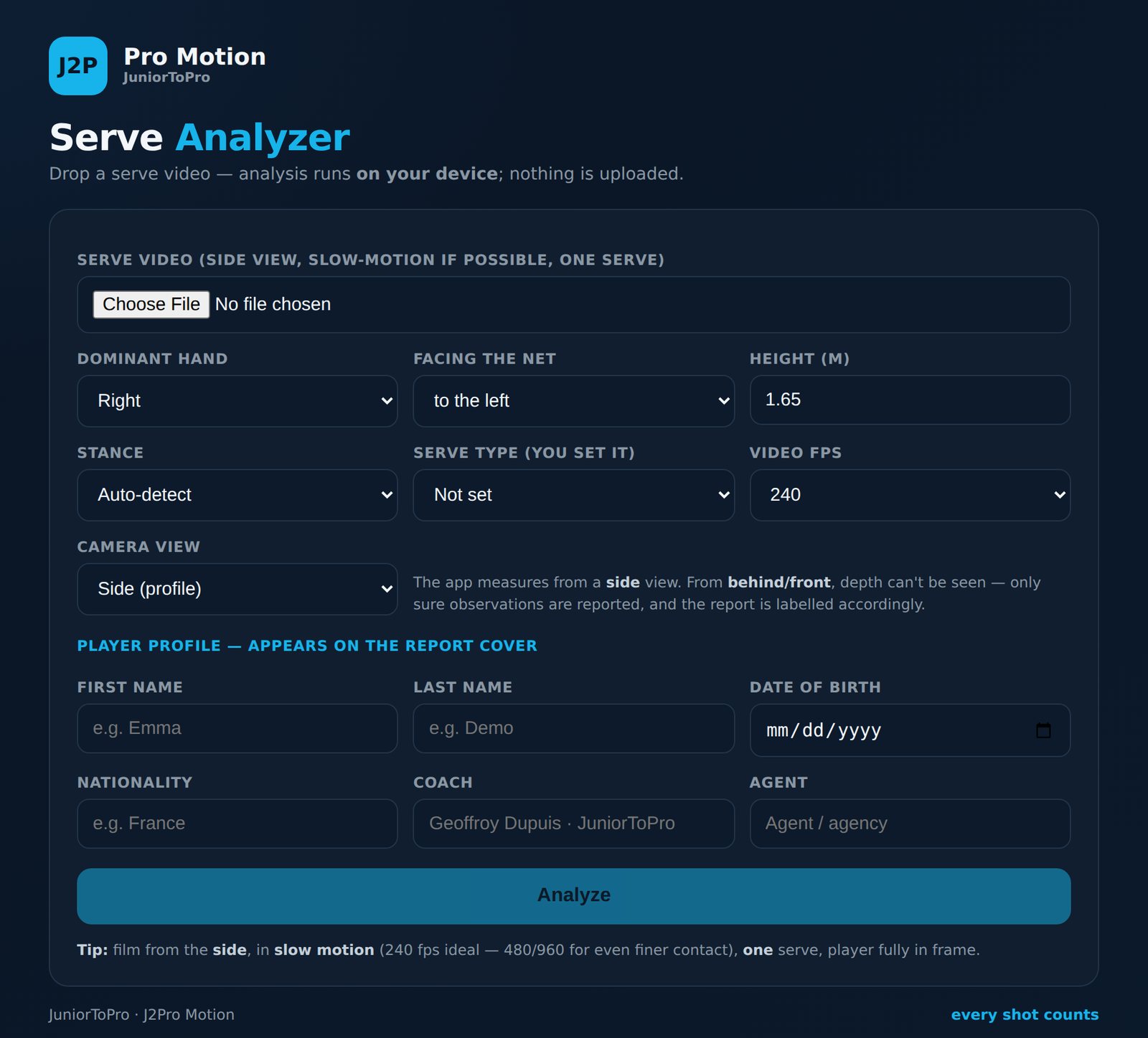
J2Pro Motion serve analyzer setup: side view, slow motion, player profile
8 stagesKovacs & Ellenbecker serve model
30–960 fpsFrom a phone to high-speed video
3–5 servesConsistency report: mean and spread
On deviceThe video is analysed locally — nothing is uploaded
Why biomechanics

The serve is a whip, not an arm.

Think of the serve like cracking a whip: the power starts in the handle — the legs and hips — and travels to the tip. When one link of the chain is late or missing, the arm and the shoulder pay for it. J2Pro Motion shows where the chain breaks, so the work on court targets the cause, not the symptom.

01

Objective, not guessed

The key positions are anchored by the coach on the video. The report only states what the camera can really see — nothing is guessed.

02

Performance and prevention

Footwork and trophy-position load are read against the research on shoulder and elbow stress, to protect young players while they build speed.

03

Consistency over one good serve

Three to five serves are compared. A technical change only counts when it holds across repetitions.

04

A plan, not a pile of numbers

Every report ends with strengths, priorities and session outcomes that feed the player’s training programme.

The model

8 stages, 3 phases.

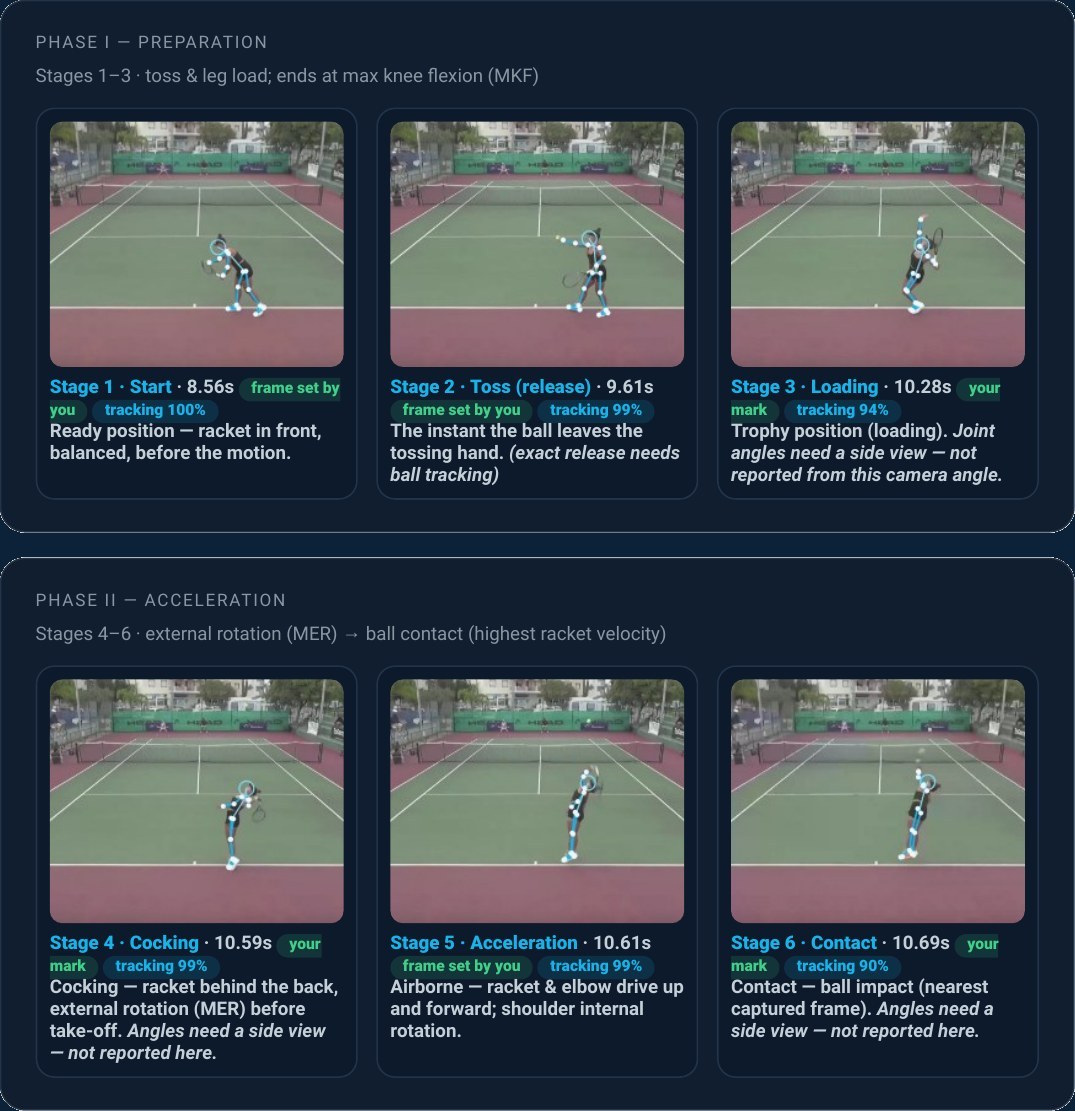
J2Pro Motion follows the 8-stage serve model of Kovacs & Ellenbecker, grouped in three phases: preparation, acceleration and follow-through. The stages in green are anchored by the coach on the video.

Preparation · 1StartStance, balance and rhythm before the toss.
Preparation · 2TossBall release, arm path and toss placement.
Preparation · 3Loading · TrophyKnee bend, shoulder tilt and the trophy position.
Preparation · 4CockingRacket drop and external rotation of the shoulder.
Acceleration · 5AccelerationLeg drive, trunk rotation and arm extension.
Acceleration · 6ContactContact height, body angle and extension.
Follow-through · 7DecelerationHow the arm and trunk slow the racket down.
Follow-through · 8FinishLanding, balance and recovery for the next ball.
The report

What a J2Pro Motion report contains.

Each section is linked to the scientific reference it comes from, so the player, the family and the staff can see why a priority matters.

1Serve overviewThe 8 stages on the player’s own video, with the key frames.
2Footwork & trophy-position loadStance, knee bend and the load placed on the shoulder at the trophy position (Martin).
3Lower-body chainHow the legs and hips start the chain (Genevois, Reid).
4Upper-body chainTrunk, shoulder and arm timing up to contact (Matsuo, Hernández-Davó).
5Metrics tableAngles and timings, with mean and spread over 3 to 5 serves.
6Strengths & prioritiesWhat to keep, and the 2 or 3 changes that matter most.
7Session outcomesConcrete targets for the next training sessions.
8Setup notesCamera view and frame rate, and what a side, front or back view can and cannot measure.
A real report, anonymised

The question came from an agent.

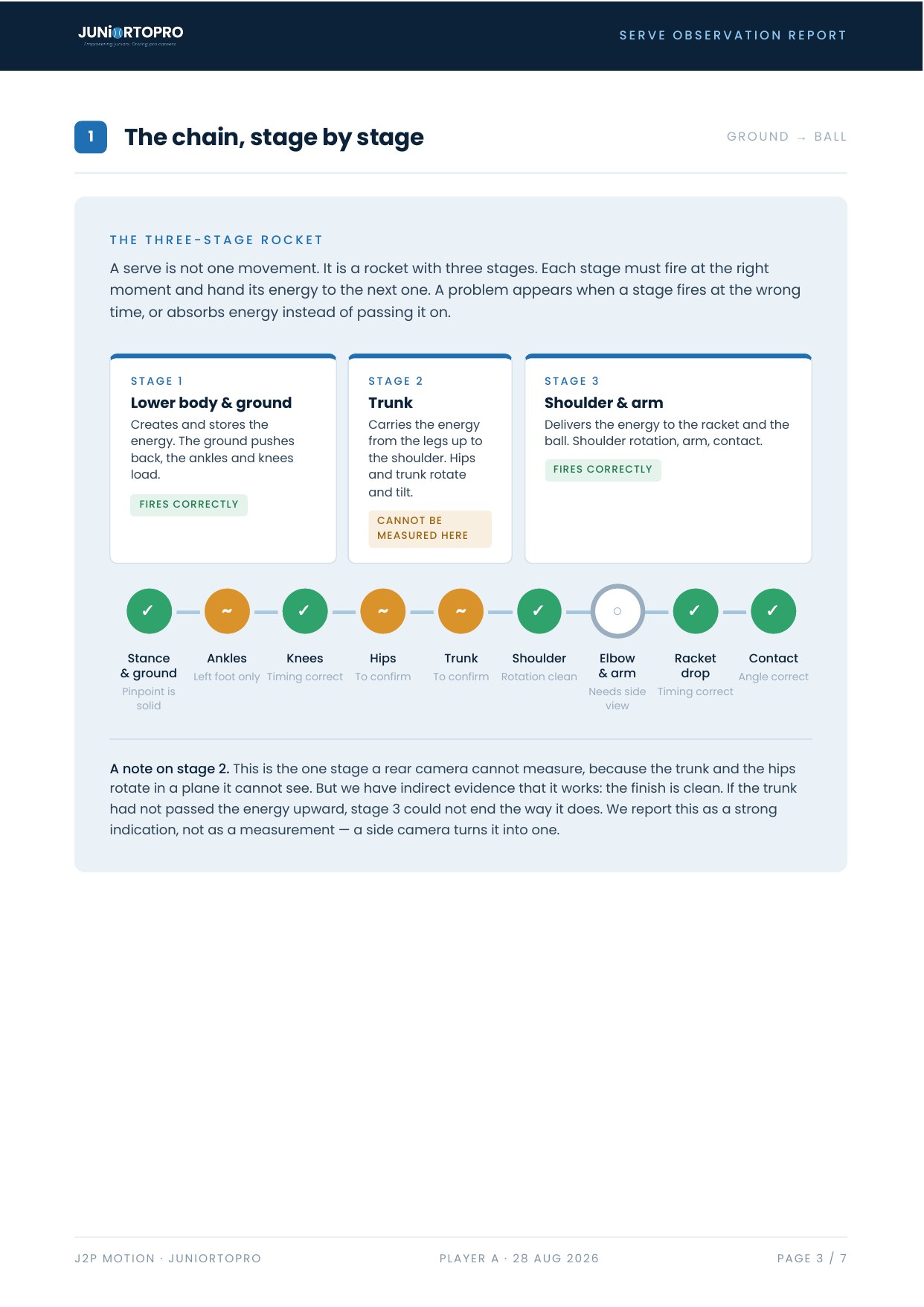
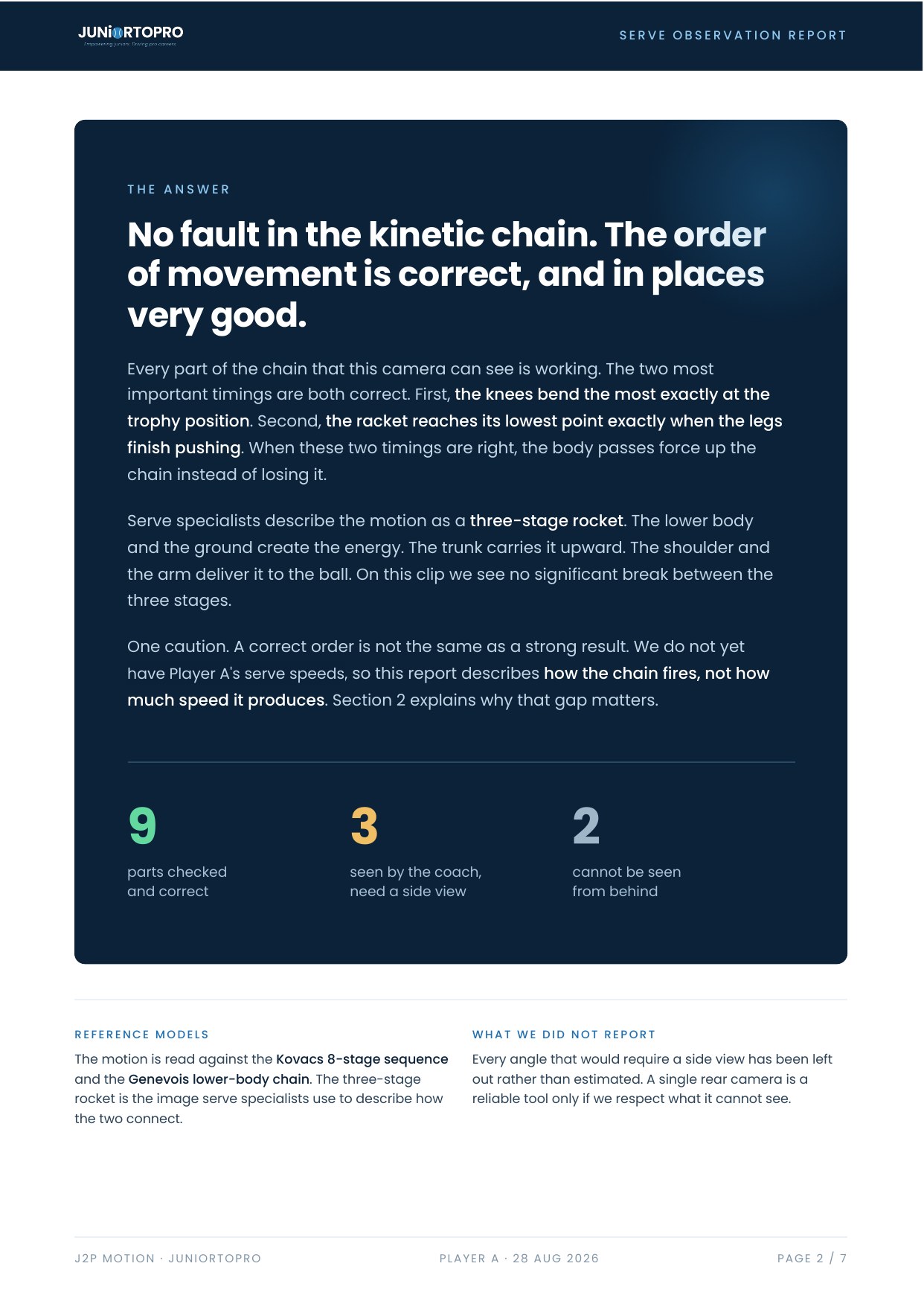
A WTA-ranked player’s agent asked: is there a fault in the kinetic chain of her serve? The answer, in 7 pages: no fault — 9 checkpoints confirmed, 3 reported as observations to confirm, 2 not reported because a rear camera cannot see them. Read the full case study →
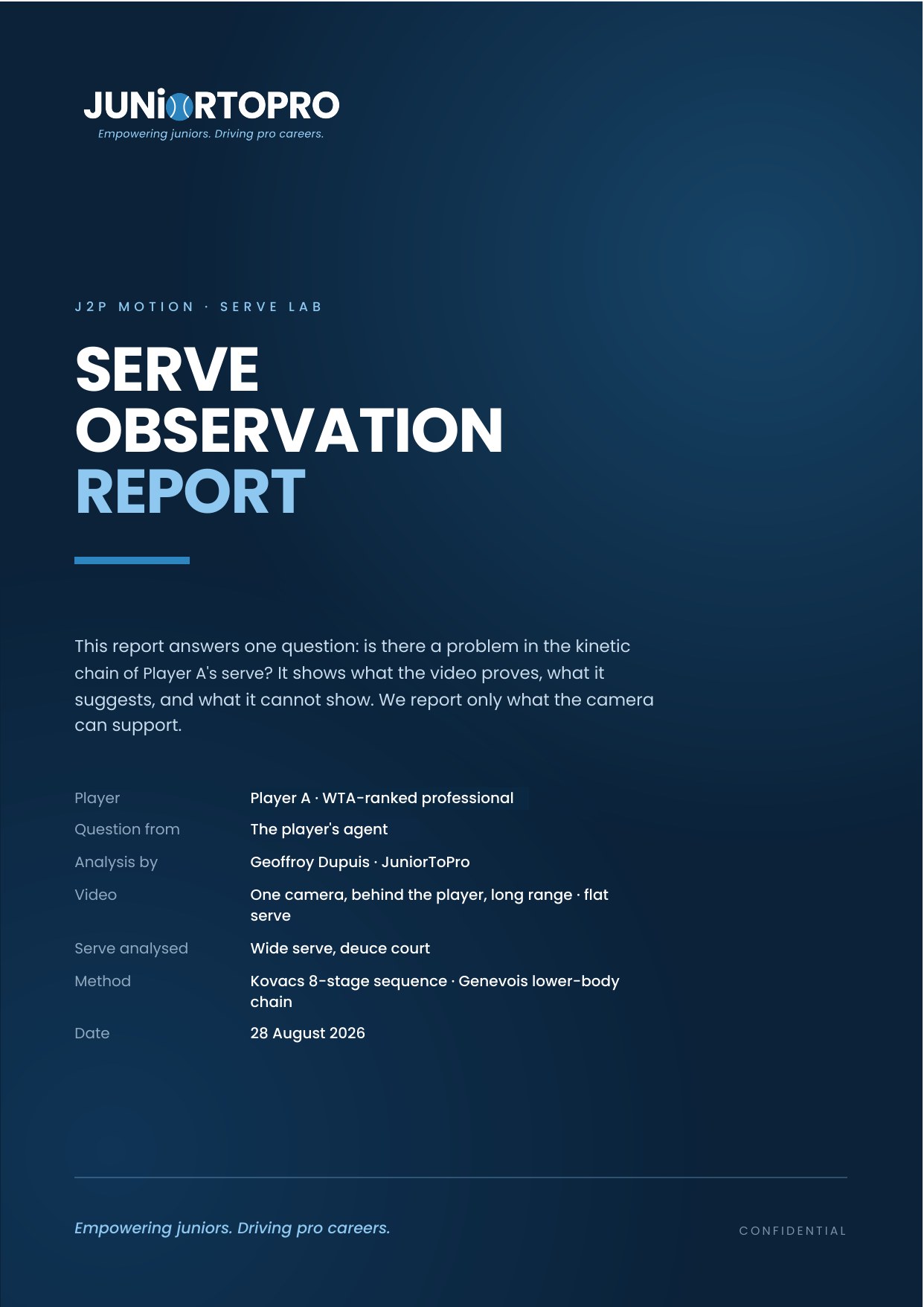
J2Pro Motion Serve Observation Report cover, anonymised
Cover — the question and the method
J2Pro Motion report: the answer, no fault in the kinetic chain
The answer — 9 correct, 3 to confirm, 2 not visible
J2Pro Motion report: the kinetic chain stage by stage, the three-stage rocket
The chain, stage by stage
J2Pro Motion serve report: stage images from preparation to acceleration, anonymised
How to film

A phone, a side view and one serve.

The best results come from a simple setup. The analyzer asks for the player’s dominant hand, height, stance, serve type and frame rate, and adapts the report to the camera view.

  • Film from the side, player fully in frame
  • Slow motion: 240 fps is ideal, 480–960 fps for an even finer contact
  • One serve per video; 3 to 5 videos for the consistency report
  • Optional: scale calibration and a Baseline Vision session summary
From video to a technical plan

Where the report goes next.

J2Pro Motion is used by Geoffroy Dupuis in his coaching work. It is not sold as a separate app. The report becomes goals and sessions in the player’s J2Pro Circuit app, and the next analysis measures the change.

Step 1FilmSlow-motion side view, 3 to 5 serves, in training or match conditions.
Step 2AnalyseThe coach anchors the key positions; the tool measures the 8 stages and the kinetic chain.
Step 3ReportStrengths, priorities and session outcomes, shared with the player and the staff.
Step 4TrainPriorities become measurable goals in J2Pro Circuit, alongside the physical work with Kinvent tools.
Step 5Re-testA new analysis confirms whether the change holds across repetitions.
Every shot counts. Start with the serve.Book a call to plan a serve analysis, in Montpellier or on tour.